
Hyundai’s best-selling Creta is widely expected to enter its next generation in 2027, and while the company has not officially revealed the SUV yet, a fresh set of digital renders offers an exciting glimpse into what the future model could look like. Created by automotive rendering artists based on industry expectations, spy shots, and Hyundai’s evolving global design philosophy, these illustrations imagine a more futuristic Creta featuring sharper styling, premium proportions, and electrification-ready architecture.
The renders depict a significant departure from the current second-generation Creta’s softer curves toward a more upright, boxy, and muscular SUV stance. Inspired in part by Hyundai’s Crater concept (unveiled at AutoMobility LA in 2025) and elements from the brand’s EV design cues (such as those seen on the Ioniq range), the front fascia is expected to feature a split lighting setup. This includes pixel-style or thick LED daytime running lights positioned above the main headlamps, a flatter and more upright bonnet, wider grille treatments, and prominent black cladding on the wheel arches and lower body for a rugged yet modern appearance.
From the side, the next-gen Creta appears longer and more assertive, with strong shoulder lines, sculpted wheel arches, flush door handles (a more premium touch), larger alloy wheels (possibly up to 18- or 19-inch), and a relatively upright windshield that prioritizes interior space. The rear is envisioned with connected LED taillights (potentially incorporating pixel elements), a cleaner tailgate, and a redesigned bumper that emphasizes width and presence. Overall proportions are projected to grow, with length approaching around 4,500 mm (up from the current 4,330 mm), contributing to a more substantial road presence while remaining competitive in the mid-size SUV segment.
Underpinning these design changes is the expected move to Hyundai-Kia’s newer K3 platform (shared with the second-generation Kia Seltos). This architecture promises better structural rigidity, improved crash safety, lower NVH levels, and more efficient packaging. The result should be a longer wheelbase, greater cabin space (especially for rear passengers), and potentially more boot capacity, while supporting a range of powertrains including hybrids.
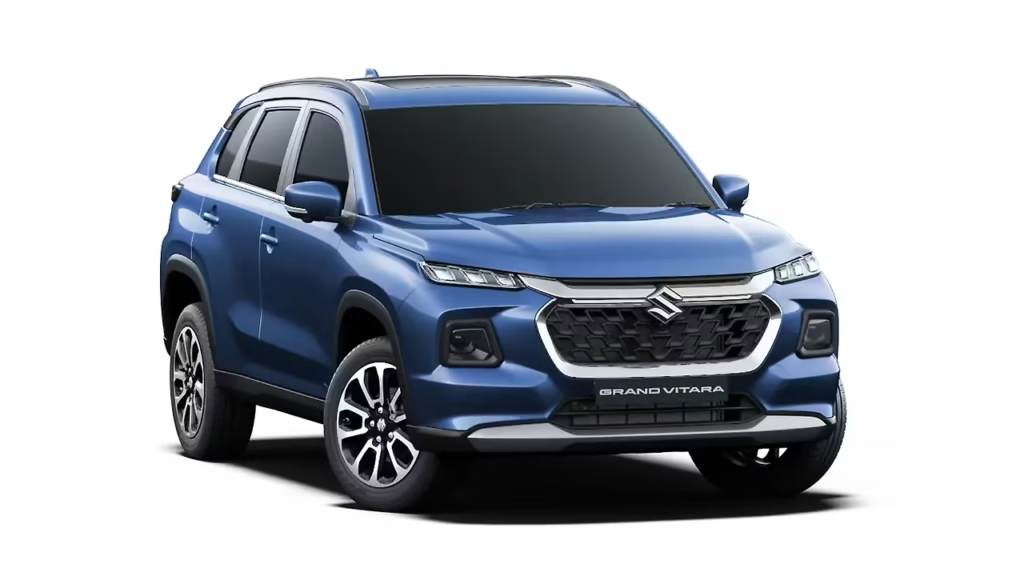
Powertrain expectations balance continuity with progress. The proven 1.5-litre naturally aspirated petrol, 1.5-litre turbo-petrol, and 1.5-litre diesel engines are likely to carry over, paired with familiar manual and automatic options (including CVT, DCT, and torque-converter gearboxes). The standout addition is a strong hybrid variant, anticipated to use an electrified version of the 1.5-litre petrol engine (with electric motors and a battery pack). This setup aims to deliver improved fuel efficiency—particularly in city driving—and lower emissions, positioning the Creta against rivals like the Toyota Urban Cruiser Hyryder and Maruti Suzuki Grand Vitara. The hybrid may arrive at launch or shortly afterward, with the platform designed to be electrification-ready from the start. In some global markets, the model (potentially badged as Kona) could offer different hybrid configurations.
Inside, the renders and spy-based expectations point to a cleaner, more upmarket dashboard with Hyundai’s Pleos Connect system. This is likely to feature larger dual screens (or a combination of a digital instrument cluster and a prominent central touchscreen), supporting over-the-air updates, advanced connectivity, and AI features. Premium materials, dual-tone themes, ventilated and powered seats, rear “boss mode” functionality, dual-zone climate control, and enhanced ADAS (Level 2 or higher) are widely anticipated. Safety is expected to be a priority, with ambitions for a strong Bharat NCAP rating and more standard equipment across variants.
Spy testing of camouflaged prototypes (codenamed SX3) has been underway in markets including India, South Korea, and elsewhere, indicating development is advanced. A global reveal is possible in late 2026, with the India launch targeted for 2027. As one of India’s most popular SUVs, the next-gen Creta will need to defend its dominance in an increasingly crowded segment filled with feature-rich and hybrid-equipped competitors.
These digital renders remain speculative interpretations rather than official designs, but they align closely with spy evidence and Hyundai’s recent design direction. If the production model stays true to this vision, the third-generation Creta should deliver bolder styling, greater space and refinement, modern technology, and hybrid efficiency—reinforcing its position as a segment benchmark when it arrives. Official details from Hyundai are still awaited.