In a market teeming with over 600 players vying for dominance, TVS Motor Company is carving out a notable niche in India’s burgeoning electric three-wheeler (e-3W) segment. The Chennai-based automaker, traditionally a powerhouse in two-wheelers, marked a significant milestone in November 2025 by registering its highest monthly sales yet: 2,871 units of its King EV Max passenger model and King Kargo HD EV cargo variant. This surge underscores the growing appetite for sustainable last-mile mobility solutions amid rising fuel costs, urban congestion, and supportive government policies.
Launched earlier this year, TVS’s entry into the e-3W space reflects a strategic pivot for legacy internal combustion engine (ICE) original equipment manufacturers (OEMs). With retail sales climbing month-on-month since January, the company’s cumulative deliveries reached 18,116 units from January to November 2025. This performance translates to a 2.55% market share of the total 709,506 e-3Ws sold in the period, securing TVS the No. 6 rank in a fiercely competitive landscape.
Steady Growth Trajectory: From Humble Beginnings to Record Highs
TVS’s e-3W journey began modestly, with just 133 units retailed in January 2025, primarily limited to northern and eastern states like Delhi, Bihar, Jammu & Kashmir, and West Bengal. However, the numbers tell a story of accelerating adoption:
| Month | Units Sold |
|---|---|
| January | 133 |
| February | 456 |
| March | 789 |
| April | 1,207 |
| May | 1,456 |
| June | 1,678 |
| July | 2,208 |
| August | 2,212 |
| September | 2,345 |
| October | 2,621 |
| November | 2,871 |
| Total (Jan-Nov) | 18,116 |
The data highlights key inflection points: Sales crossed the 1,000-unit threshold in April, surged past 2,000 in July, and peaked in November, capturing a 3% slice of the month’s overall e-3W pie. This consistent upward trend is no accident. As KN Radhakrishnan, Director and CEO of TVS Motor, noted earlier this year, “We are confident of reaching a prominent place in this EV three-wheeler business this year.”
Powering the Demand: Spotlight on King EV Max and King Kargo HD EV
At the heart of TVS’s success are two purpose-built models tailored for India’s diverse mobility needs.The King EV Max, TVS’s flagship passenger e-rickshaw, draws design cues from its petrol-powered King sibling while embracing zero-emission tech. Priced at approximately ₹2.95 lakh (ex-showroom), it features a 9.7 kWh lithium-iron-phosphate (LFP) battery pack, delivering a certified range of 179 km on a single charge and a top speed of 60 km/h. With three driving modes—Eco (40 km/h), City (50 km/h), and Power (60 km/h)—it balances efficiency and performance, even in water up to 500 mm deep. The model’s 11 kW motor and 40 Nm torque ensure nimble handling in crowded streets, while Bluetooth connectivity via TVS SmartXonnect adds 26 smart features like real-time tracking and fleet management.
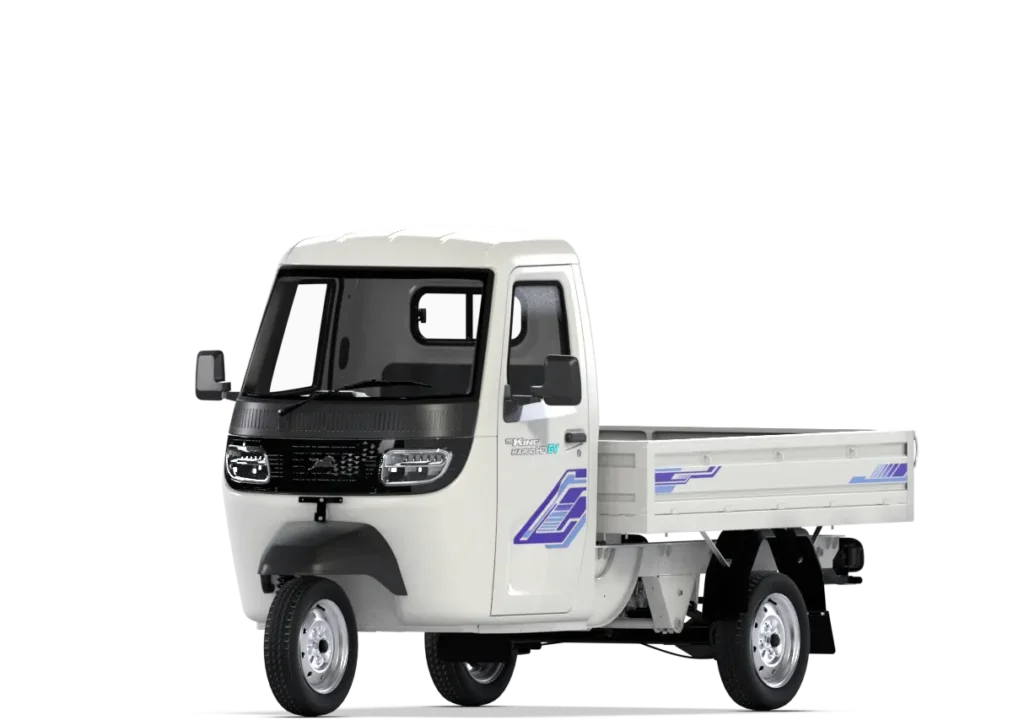
Complementing it is the King Kargo HD EV, introduced in August 2025 to tap the cargo segment. Starting at ₹3.85 lakh (ex-showroom), this beast boasts an 8.9 kWh LFP battery for a 156 km range (143 km real-world) and a class-leading 6.6-foot loading deck with a low 703 mm height for easy access. Its 11.2 kW motor accelerates from 0-30 km/h in 5.9 seconds—even under load—and supports a 998 kg gross vehicle weight (GVW). Available initially in Delhi-NCR, Rajasthan, Bengaluru, and Maharashtra, it includes LED lighting, ventilated cabins, and a Power Gear Mode for torque-heavy hauls. A CNG variant is slated for late 2025, offering fuel flexibility.
These models aren’t just selling; they’re winning bulk orders. In May, TVS inked a deal with Chennai-based cab aggregator OOR Cabs for 500 King EV Max units, with deliveries set to wrap by March 2026. Such partnerships highlight TVS’s appeal to fleet operators seeking cost savings—electric operation slashes per-km expenses to about ₹1.28 versus ₹3.21 for petrol equivalents.
Navigating a Crowded Arena: TVS’s Edge in a Booming Market
India’s e-3W market is the world’s largest, with FY2025 sales hitting nearly 700,000 units—an 11% year-on-year rise. Valued at USD 1.16 billion in 2024, it’s projected to reach USD 4.08 billion by 2034 at a 13.4% CAGR, fueled by subsidies, falling battery prices, and last-mile delivery booms from e-commerce giants. EVs now claim 57% of total three-wheeler sales, up from lower shares in prior years, as pollution norms and incentives like the FAME-III scheme accelerate the shift.
Yet, competition is intense. Legacy rivals like Mahindra Last Mile Mobility (96% EV penetration in passenger 3Ws), Bajaj Auto (leading with 43,798 L5 passenger units in October, 17% electric), and Piaggio Vehicles dominate, alongside pure-plays like TI Clean Mobility and Omega Seiki. TVS differentiates through its integrated ecosystem: From advanced LFP batteries for safety and longevity (six-year/1.5 lakh km warranty) to telematics for fleet optimization, it’s building a moat around reliability and connectivity.
Challenges persist—battery supply chains and charging infrastructure lag in tier-2/3 cities—but TVS is countering with phased expansions and potential tie-ups, like rumored collaborations with Hyundai for tech and manufacturing.
The Road Ahead: A Greener, Smarter Mobility Future
TVS Motor’s November triumph isn’t isolated; it’s part of a broader 147% year-on-year three-wheeler sales growth to 21,667 units, contributing to the company’s overall 30% monthly sales jump to 519,508 units. As India eyes 50-60% e-3W penetration by 2030, TVS’s blend of heritage engineering and EV innovation positions it for deeper inroads.
For operators and commuters alike, the King duo promises not just affordability but a smarter, cleaner ride. In a nation where three-wheelers ferry millions daily, TVS is proving that electrification isn’t a disruption—it’s the new normal. With network expansions and fresh incentives on the horizon, expect TVS to rev even higher in 2026.