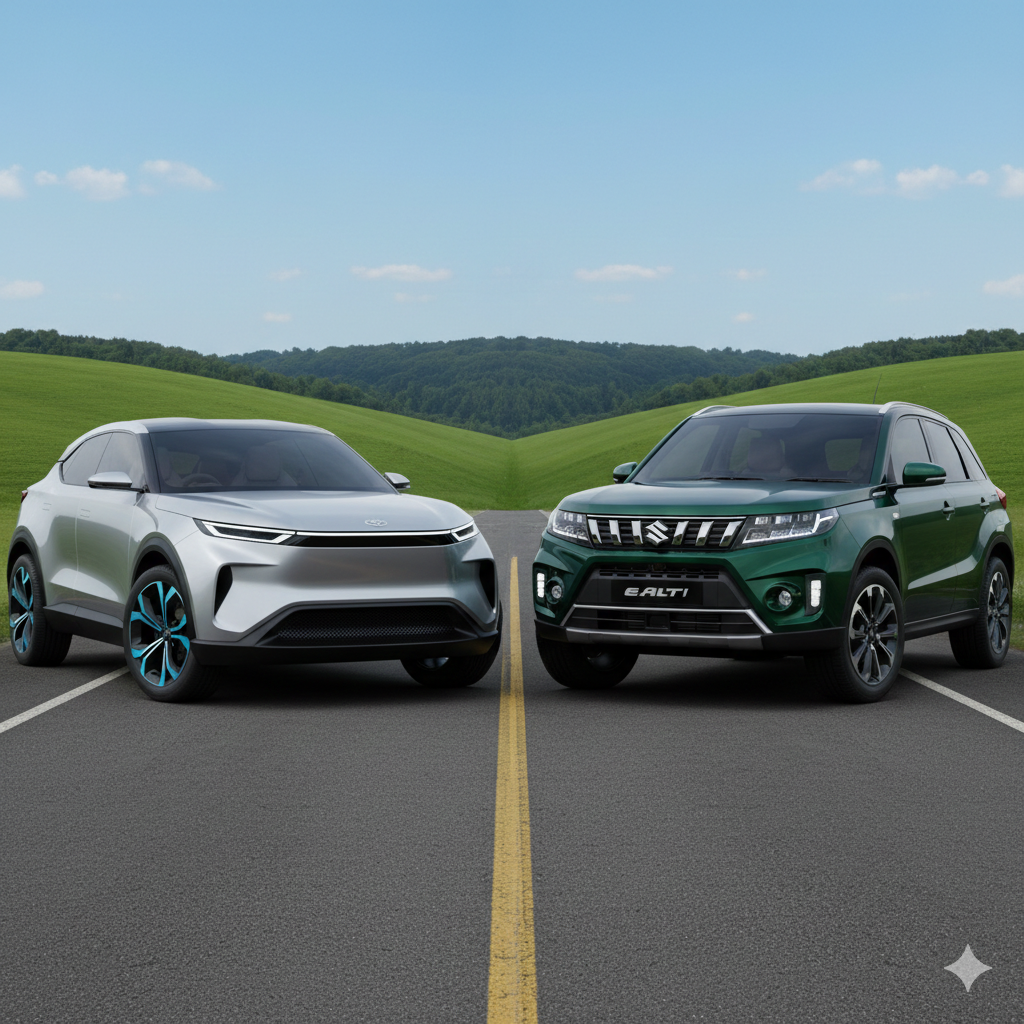
Toyota has unveiled the Urban Cruiser Ebella, its version of the Suzuki eVitara, marking another step in the Toyota–Suzuki global EV partnership. While both electric SUVs share the same underlying platform and powertrain, Toyota has given the Ebella a distinct identity—especially on the outside.
So, what exactly is different, and what remains the same? Here’s a detailed breakdown.
Exterior Design: Familiar Shape, Distinct Identity
Front Design: Completely New for Toyota
The most noticeable difference lies at the front. Unlike the eVitara, which features two distinct headlamp sections, the Urban Cruiser Ebella uses a single, unified headlamp cluster.
- Headlights are positioned at the outer edges
- DRL signature and internal layout are completely different
- The bumper is all-new, featuring smoother and cleaner surfacing
- Subtle vents guide airflow around the tyres for improved aerodynamics
In contrast, the eVitara adopts a more aggressive approach with sharper cuts and stronger creases. The Ebella, true to Toyota’s recent design language, looks cleaner and more understated.
Bonnet and Fog Lamps
- The Ebella gets a new bonnet with sharp character lines at the outer edges, a signature seen on newer Toyota models
- Unlike the eVitara, the Ebella does not get fog lamps
- The eVitara retains a slightly sportier, more rugged visual appeal
Side Profile: Mostly Identical
From the side, both electric SUVs are nearly identical, with only subtle changes:
- Toyota badging on the alloy wheels
- “BEV” branding (Toyota’s terminology for battery electric vehicles)
- Same body cladding
- Same door-mounted rear door handles
The silhouette, proportions, and surfacing remain unchanged, clearly reflecting the shared platform.
Rear Design: Same Panels, New Light Signature
At the rear, the sheet metal and plastic panels remain the same, but Toyota has differentiated the Ebella through lighting details.
- A new tail-lamp signature featuring segmented dot-style illumination
- Design mirrors the front lighting theme
- Toyota badging along with Urban Cruiser and Ebella branding
The eVitara uses a different tail-lamp pattern, making the rear one of the easiest ways to tell the two apart.
Interior: Almost Identical Cabin
Step inside, and the differences nearly disappear.
- Same dashboard layout
- Same continuous dual-screen setup (instrument cluster + infotainment)
- Identical controls, switches, and layout
- Same overall cabin design and materials
The only visible change is the Toyota logo on the steering wheel.
Connectivity System
While the hardware remains the same, the Ebella gets Toyota’s proprietary connected-car software suite, replacing Suzuki’s system found in the eVitara.
Powertrain & Battery: Exactly the Same
Mechanically, the Toyota Urban Cruiser Ebella is identical to the Suzuki eVitara.
Key Specifications (Preliminary)
- Electric motor output: 174 hp
- Torque: 189 Nm
- Battery options:
- 49 kWh
- 61 kWh
- Claimed range: Up to 543 km (standard test cycle)
Final performance figures and real-world range data are yet to be revealed.
Pricing & Launch Timeline
As with the Suzuki eVitara, Toyota has not announced pricing yet for the Urban Cruiser Ebella. More details are expected closer to the official market launch.
Final Thoughts
The Toyota Urban Cruiser Ebella is essentially a re-skinned eVitara, offering Toyota buyers a familiar electric SUV with brand-specific styling and software tweaks. While the mechanicals remain unchanged, Toyota’s cleaner design approach and trusted brand appeal could attract a different set of customers.
For now, the key decision between the two will likely come down to:
- Design preference
- Brand loyalty
- Dealer and service experience
More clarity on pricing and variant strategy will ultimately determine how well the Ebella performs in the competitive electric SUV space.