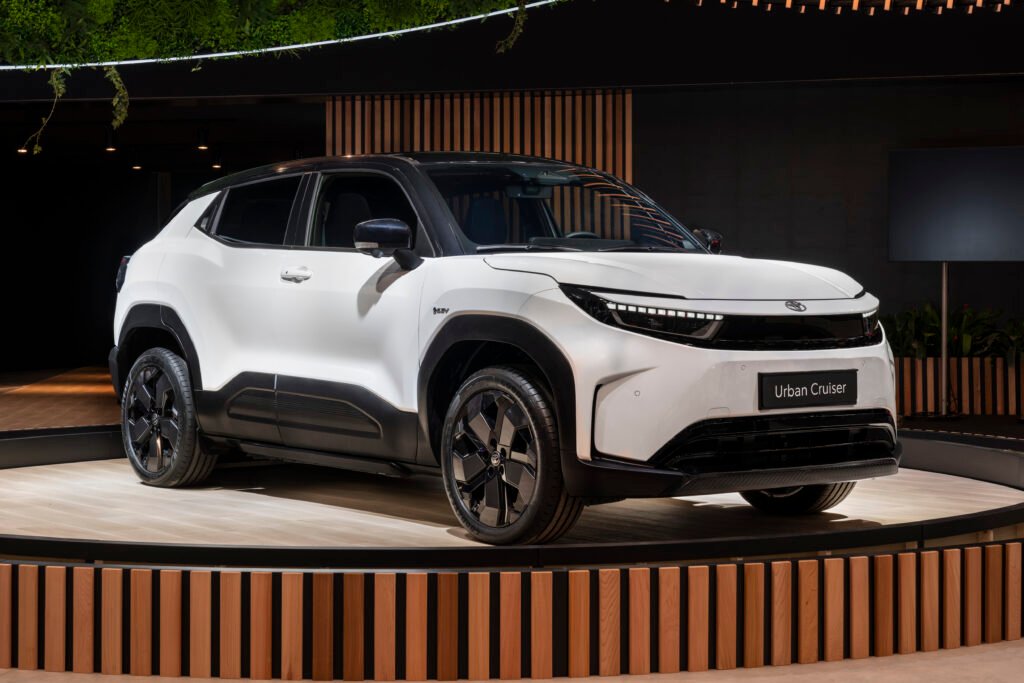
In a bold stride toward electrifying Southeast Asia’s automotive landscape, Toyota has officially unveiled the Urban Cruiser BEV at the Gaikindo Jakarta Auto Week (GJAW) 2025. This compact electric SUV marks the Japanese giant’s latest push into the battery electric vehicle (BEV) segment, arriving as a fully built import from India and slotted strategically below the more premium bZ4X. As Indonesia’s EV market heats up amid government incentives and rising consumer interest, Toyota’s dual-SUV offensive—pairing the locally assembled bZ4X with the nimble Urban Cruiser—signals a multifaceted strategy to capture diverse buyer segments.
The GJAW 2025 event, held at the Indonesia Convention Exhibition (ICE) in BSD City, Tangerang, served as the perfect stage for Toyota’s reveal. While competitors paraded futuristic concepts, Toyota focused on production-ready electrified models, underscoring its commitment to “multi-pathway” electrification. The Urban Cruiser BEV, imported intact (CBU) from Maruti Suzuki’s Gujarat facility in India, is priced at an aggressive Rp 759 million (approximately Rs 40.5 lakh or $48,000) on-the-road (OTR) in Jakarta. This positions it as an accessible entry point for urban commuters seeking style, efficiency, and zero-emissions driving without breaking the bank.
A Smarter Play: Local Assembly Reshapes the bZ4X Landscape
To fully appreciate the Urban Cruiser’s role, it’s essential to contextualize it against its bigger sibling, the bZ4X. Previously imported from Japan as a complete built-up (CBU) unit, the bZ4X commanded prices north of Rp 1 billion, rendering it a luxury outlier in Indonesia’s nascent EV ecosystem. That changed dramatically at GJAW 2025, where Toyota announced local assembly at its PT Toyota Motor Manufacturing Indonesia (TMMIN) plant in Karawang, West Java, set to ramp up by late 2025.The move slashes the bZ4X’s OTR Jakarta price to Rp 799 million (about Rs 42.93 lakh or $51,000)—a steep drop that democratizes access to Toyota’s flagship EV.
No compromises on specs here: the front-wheel-drive (FWD) configuration retains a robust 73.1 kWh nickel-manganese-cobalt (NMC) battery, delivering up to 525 km of WLTP-rated range. Power comes from a permanent magnet synchronous motor churning out 221 hp (165 kW) and 268 Nm of torque, ensuring brisk acceleration and highway composure.
Premium touches like a 14-inch infotainment touchscreen, panoramic sunroof, and dual wireless chargers further elevate its appeal for families and professionals. By localizing production—importing knocked-down (CKD) kits rather than fully built vehicles—Toyota not only curbs costs but also streamlines supply chains, promising faster service and better parts availability. This contrasts sharply with the Urban Cruiser BEV, which remains a CBU import for now, though Toyota hasn’t ruled out future localization. Together, the duo occupies a compelling price bracket, with the Urban Cruiser undercutting the bZ4X by around Rp 40 million, targeting budget-conscious buyers who prioritize compactness over long-haul prowess.
Urban Cruiser BEV: Compact Power for City Dwellers
The Urban Cruiser BEV isn’t just a smaller bZ4X—it’s a purpose-built urban warrior, drawing from Toyota’s alliance with Suzuki to blend affordability with modern EV tech. Measuring approximately 4,285 mm in length with a 2,700 mm wheelbase, it offers a spacious five-seater cabin despite its subcompact footprint, ideal for Jakarta’s congested streets and archipelago adventures.
Under the hood (or rather, the blanked-off grille), it borrows powertrain DNA from the Suzuki eVitara, with two battery options on the global menu: a 49 kWh pack for entry-level models and a 61 kWh unit for extended range. In FWD guise, expect around 174 hp from the front-axle motor, with torque at 193 Nm; an optional all-wheel-drive (AWD) variant adds a rear motor for up to 184 hp total and superior traction on slippery roads.
Toyota touts a WLTP range exceeding 500 km for the larger battery, bolstered by lithium-iron-phosphate (LFP) chemistry for durability and fast DC charging support—topping up from 10-80% in under 30 minutes at compatible stations. Design-wise, the Urban Cruiser channels Toyota’s “hammerhead” aesthetic with vertical LED DRLs, a seamless LED light bar, and chrome accents for a premium vibe. Inside, a horizontal dashboard maximizes visibility, complemented by dual digital screens, wireless charging, and elevated seating for that commanding SUV feel. Safety features, including advanced driver aids like adaptive cruise control and lane-keeping assist, come standard, aligning with Toyota’s safety-first ethos. In Indonesia, where Chinese brands like BYD and Wuling dominate the sub-Rp 500 million EV space, the Urban Cruiser’s Rp 759 million tag positions it as a premium-yet-attainable alternative. Early deliveries are underway, with Toyota reporting strong initial interest at GJAW. This is our solution for sustainable mobility in a new segment,” said PT Toyota-Astra Motor President Director Hiroyuki Ueda during the launch.
Eyes on India: A Hometown Hero Heads Home?
The Urban Cruiser BEV’s Indonesian debut carries extra intrigue for Indian audiences, as it’s essentially a rebadged export of Maruti Suzuki’s eVitara, produced at the Hansalpur plant in Gujarat.
Showcased as the Urban BEV Concept at the Bharat Mobility Global Expo in January 2025, it’s poised to become Toyota’s first mass-market EV in India—a landmark for the brand’s Kirloskar joint venture. Launch timelines point to the first half of 2026, with some reports suggesting as early as February Priced between Rs 15-20 lakh ex-showroom, it will square off against heavyweights like the Tata Nexon EV, Mahindra XUV400, MG ZS EV, and the upcoming Hyundai Creta EV.
With India’s EV adoption surging—bolstered by PLI subsidies and expanding charging infrastructure—the Urban Cruiser could tip the scales for Toyota, blending Suzuki’s cost efficiencies with Toyota’s reliability badge. Will local production follow in India? Unlikely at launch, given the export focus, but Toyota’s track record suggests scalability if demand materializes. For now, the Indonesia introduction serves as a real-world proving ground, ironing out logistics for the home market.