The next big EV launch from Tata Motors is set to be the much-awaited Sierra.EV. The carmaker had earlier confirmed that the electric SUV would arrive in the first quarter of financial year 2027 (FY27), which typically translates to April, May, or June 2026. We have now learnt that the launch will commence in May 2026
This development marks a significant milestone for Tata Motors as it revives the iconic Sierra nameplate in an all-electric avatar, nearly three decades after the original model captured the hearts of Indian SUV enthusiasts. The Sierra.EV is expected to strengthen Tata’s already dominant position in the country’s electric vehicle market, where the company currently holds a substantial share.
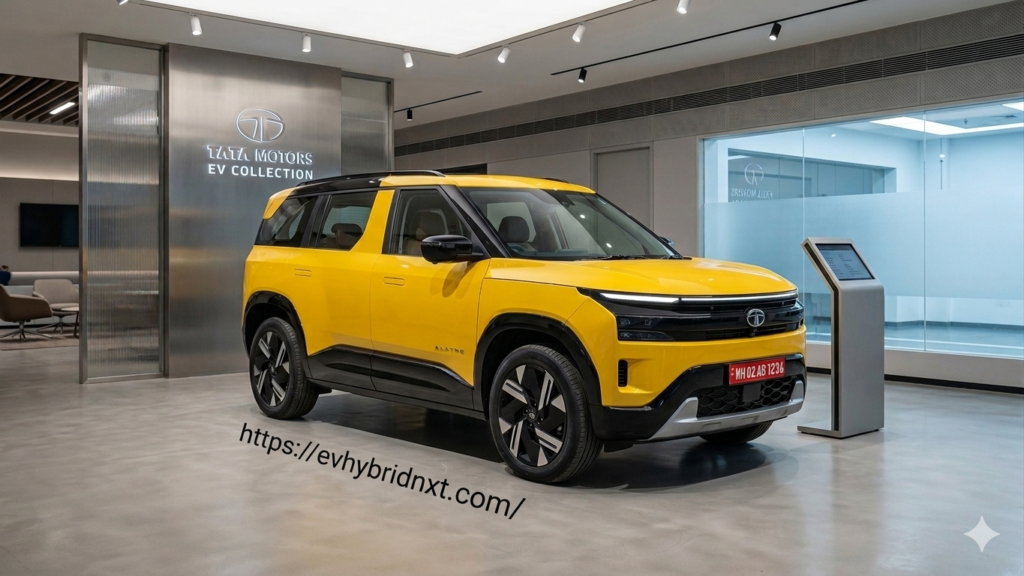
The original Tata Sierra was known for its rugged, boxy design and go-anywhere capability. The new Sierra.EV retains that distinctive character while embracing a contemporary electric identity. Spy shots and design patents suggest it will feature a squared-off silhouette, flat bonnet, upright stance, connected LED lighting, a closed-off front grille (body-coloured for the EV), blacked-out pillars, and a full-width rear LED tail lamp. The cabin is likely to mirror the ICE Sierra’s layout to a large extent, with premium touches such as a three-screen setup (including a large central infotainment and passenger display), panoramic sunroof, ventilated seats, premium audio, and advanced driver aids.
Production of the Sierra.EV will take place at Tata’s Sanand plant in Gujarat, the same facility manufacturing the recently launched ICE-powered Sierra. This shared manufacturing setup is expected to help optimise costs and enable faster scaling.
The Sierra.EV is built on Tata’s advanced Acti.EV (Gen 2) platform, the same architecture underpinning models like the Curvv.EV. It will be offered with multiple battery options, likely including 55 kWh (shared with lower Curvv.EV variants) and larger 65 kWh or even 75 kWh packs for higher trims. Real-world range is anticipated to hover between 400–500+ km on a single charge, depending on the battery and driving conditions.
Buyers can choose between rear-wheel-drive (RWD) and all-wheel-drive (AWD) configurations, making the Sierra.EV the second Tata EV (after the Harrier.EV) to offer dual-motor AWD capability. This setup promises strong performance, quick acceleration, and better traction — especially useful on wet or uneven Indian roads. Fast-charging support, along with features like Vehicle-to-Load (V2L) and Vehicle-to-Vehicle (V2V) functionality, are also expected.
The Sierra.EV will slot into Tata’s electric SUV lineup above the Curvv.EV and Nexon.EV but below the flagship Harrier.EV. It is aimed at the popular mid-size electric SUV segment and is likely to be priced in the ₹18–25 lakh (ex-showroom) range, making it competitively positioned against rivals such as:
- Hyundai Creta Electric
- Mahindra BE 6 / XEV 9e
- Maruti Suzuki e Vitara
Its combination of retro-modern styling, spacious cabin, multiple powertrain choices, and Tata’s proven EV reliability could give it a strong edge in this hotly contested space.
With the launch now pinned for May 2026, Tata Motors is expected to ramp up pre-launch activities, including more spy shots, teaser campaigns, and possibly a concept or near-production showcase in the coming weeks. Bookings may open shortly after the official unveiling, with deliveries likely to commence in the second half of 2026.The Sierra.
EV represents more than just another product launch for Tata — it is the electrified return of a legendary name that carries significant emotional value for many Indian buyers. If priced aggressively and equipped with the right mix of range, features, and performance, it has the potential to become one of the best-selling electric SUVs in its segment.
Stay tuned for more updates as Tata Motors prepares to electrify yet another chapter in its storied SUV history. The May 2026 launch window positions the Sierra.EV as one of the most important new-energy vehicle debuts of the year.