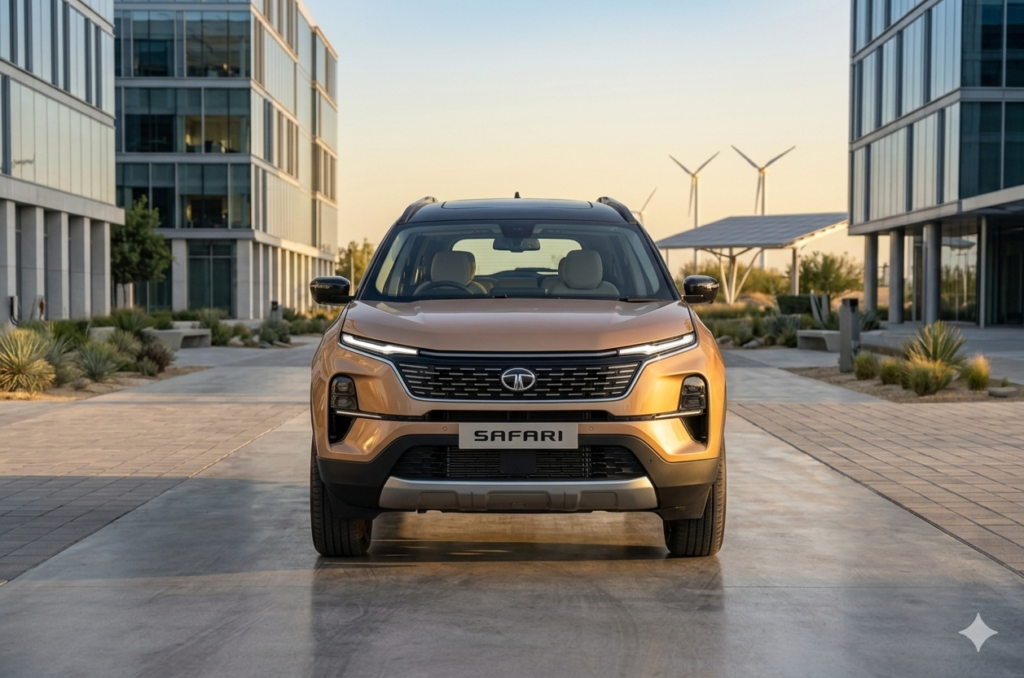
Tata Motors is gearing up to introduce an all-electric version of its popular flagship SUV, the Tata Safari EV. This upcoming model will mark a significant milestone for the company as it becomes Tata’s first-ever three-row electric vehicle.
The Safari EV is expected to hit the market around the festive season, specifically near Diwali 2026. This timing aligns with Tata’s strategy to capitalize on heightened consumer demand during India’s biggest festive period. Production of the electric Safari is slated to begin in August 2026, giving the company sufficient time to ramp up manufacturing ahead of the launch.
Internally, the project is codenamed Tayrona. It will share its core underpinnings with the recently launched Harrier EV, allowing for a faster development cycle. Both models are built on Tata’s acti.ev+ platform — an adapted electric architecture derived from an existing ICE (internal combustion engine) base rather than a dedicated “born-EV” skateboard platform. This approach helps Tata bring electric variants to market more quickly and cost-effectively while leveraging proven engineering
Since the Safari EV is essentially an electric derivative of the ICE Safari, it is likely to retain much of the original body shell with subtle updates to suit its zero-emission identity. Expect minor cosmetic changes such as a closed-off front grille, revised bumpers, and aerodynamic alloy wheels for better efficiency.Powertrain options are expected to mirror those of the Harrier EV, including:
- Battery packs in the range of 65 kWh and 75 kWh (with some reports hinting at even larger options).
- Rear-wheel drive (RWD) as standard.
- An optional dual-motor all-wheel-drive (AWD) setup on higher variants.
While the Harrier EV boasts impressive claimed ranges exceeding 600 km in some configurations, the heavier and larger Safari EV may see slightly lower figures in real-world conditions. It will also support fast charging, making it practical for both city commutes and long highway trips.Inside, the Safari EV should offer the same spacious three-row seating layout that has made the ICE Safari a favorite among Indian families. It will come equipped with Tata’s advanced TiDAL (Tata Intelligent Digital Architecture Layer) for enhanced connected features, software updates, and a more premium digital experience.
Once launched, the Safari EV will sit above the Harrier EV as Tata’s new flagship electric SUV. It will directly challenge the Mahindra XEV 9S (the electric version of the XUV700) and other upcoming three-row electric offerings in the premium segment. The addition of an AWD option could give Tata an edge over some rivals that currently offer only rear-wheel-drive configurations.
This move is part of Tata Motors’ broader push to electrify its entire SUV lineup. By offering electric versions of both the Harrier and Safari, the company aims to cater to customers who want the practicality of a three-row SUV without compromising on zero-emission driving.
The Safari EV represents Tata’s commitment to expanding its electric portfolio while addressing the growing demand for family-friendly EVs in India. With its combination of proven platform technology, spacious cabin, and expected strong performance, it has the potential to strengthen Tata’s leadership in the domestic EV market.While official specifications, pricing, and full feature details are still under wraps, the Safari EV is shaping up to be one of the most anticipated electric launches of 2026. Keep an eye on further updates as we move closer to the production start in August and the festive-season debut.