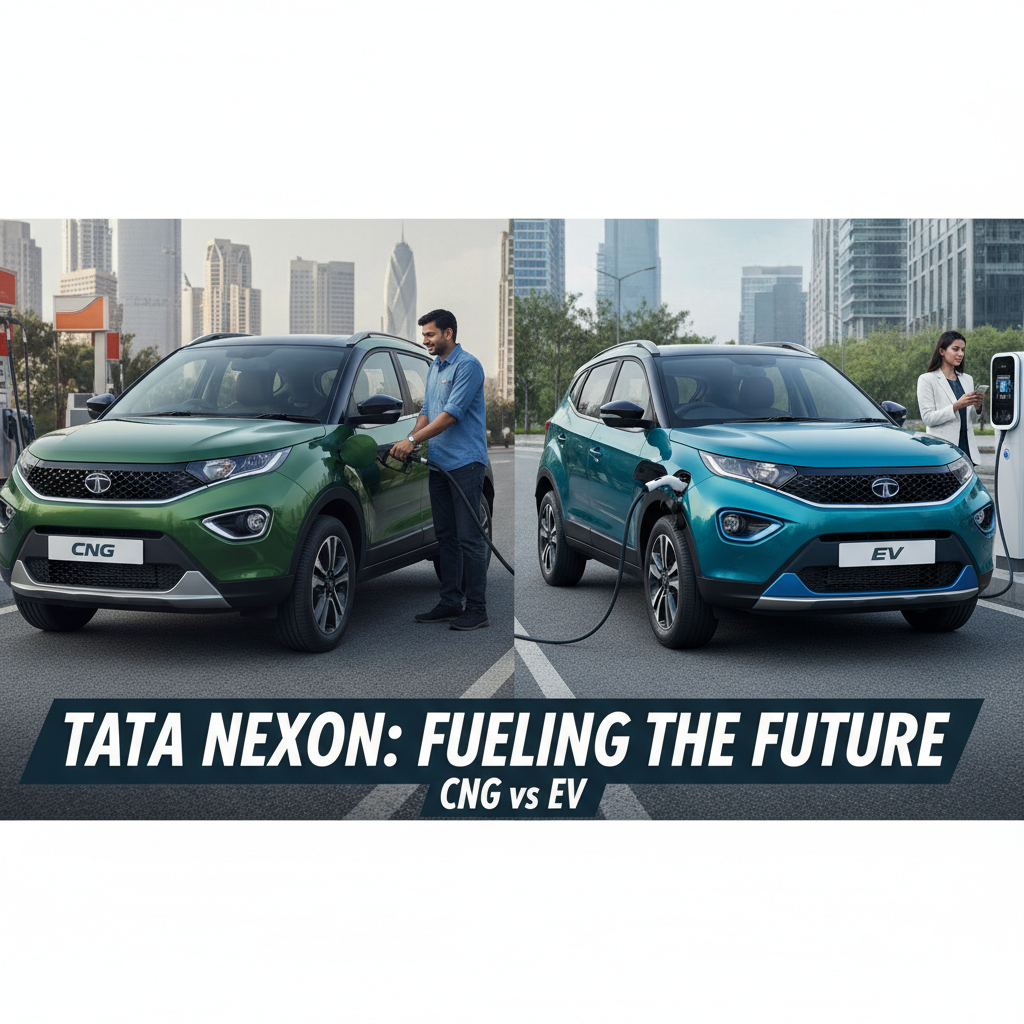
For some time, CNG cars have been a better option for buyers – for its lower running costs and lower upfront cost compared to diesel and petrol cars. But it hampers the performance and only comes with a manual gearbox (except Tiago & Tigor). Similarly, EVs also have lower running costs, but offer better performance (thanks to its torquey nature). However, its upfront cost is higher, and the charging infrastructure is in the developing phase. So, which car can be a better option? Let’s take a look at a comparison between the Tata Nexon CNG and the Tata Nexon EV.An EV or a CNG car – Which will offer a lower running cost? This has been a question for many for a long time. And today, we will be diving deep into it to know what’s best!In India’s evolving automotive landscape, where fuel prices fluctuate and environmental concerns loom large, the Tata Nexon stands out as a versatile sub-compact SUV. Tata Motors has electrified and “CNG-ified” this bestseller, making the Nexon CNG and Nexon EV direct rivals in the eco-friendly segment. Launched in late 2024, the Nexon CNG brings turbocharged efficiency to the gas game, while the Nexon EV (updated in 2025 with ADAS options) pushes boundaries in electric mobility. We’ll break down the key battlegrounds: upfront costs, running expenses, performance, infrastructure, and more. Buckle up – by the end, you’ll know which Nexon fits your drive.
Upfront Cost: CNG Takes the Lead for Budget Buyers
The sticker price is often the first hurdle for car shoppers, and here, the Nexon CNG flexes its affordability muscle. Starting at ₹8.23 lakh (ex-showroom) for the base Smart variant, it undercuts most rivals in the CNG SUV space. Top-end trims climb to around ₹14.30 lakh, still leaving room in your wallet for accessories or insurance. Contrast that with the Nexon EV, which demands a steeper entry fee. The base model with a 30 kWh battery starts at ₹12.49 lakh, but real-world pricing for the more practical 45 kWh long-range version begins closer to ₹14.80 lakh and tops out at ₹18.40 lakh for loaded ADAS-equipped variants. This premium reflects the battery tech and electric drivetrain, but government incentives like FAME-II subsidies (up to ₹1.5 lakh for EVs) can narrow the gap to as little as ₹2-3 lakh.
| Aspect | Tata Nexon CNG | Tata Nexon EV (45 kWh) |
|---|---|---|
| Starting Price (ex-showroom) | ₹8.23 lakh | ₹14.80 lakh |
| Top Price | ₹14.30 lakh | ₹18.40 lakh |
| Key Premium | Affordable entry, manual only | ADAS, auto transmission |
Verdict on Upfront: If you’re pinching pennies, CNG wins. EVs appeal to those eyeing long-term savings and tech perks.
Running Costs: EVs Charge Ahead for the Long Haul
Running costs are where the “green” debate gets real – and numbers don’t lie. With CNG at ₹76.09 per kg in major cities like Delhi as of November 2025, and electricity tariffs hovering at ₹6-8 per kWh for home charging, Let’s crunch the km. The Nexon CNG boasts an ARAI-certified mileage of 24 km/kg in real-world tests
translating to roughly ₹3.17 per km (₹76.09 / 24). That’s a steal compared to petrol’s ₹6-7/km, but it assumes frequent refills and city driving where CNG shines.Enter the Nexon EV: Its 45 kWh battery delivers up to 489 km per full charge (MIDC certified), equating to about 10.87 km/kWh efficiency. At ₹7/kWh, that’s a mere ₹0.64 per km – over 50% cheaper than CNG. Public fast chargers bump this to ₹8-10/kWh (₹0.73-0.92/km), but home charging keeps it low.Over 1 lakh km and 7 years? The EV edges out with ₹37,000 in total savings versus CNG, factoring maintenance and fuel.
| Fuel Type | Efficiency | Cost per Unit | Cost per km (Avg.) |
|---|---|---|---|
| CNG | 24 km/kg | ₹76.09/kg | ₹3.17 |
| EV | 10.87 km/kWh | ₹7/kWh | ₹0.64 |
Verdict on Running Costs: EVs dominate for high-mileage users (urban commuters averaging 20,000+ km/year). CNG suits moderate drivers wary of electricity variability.