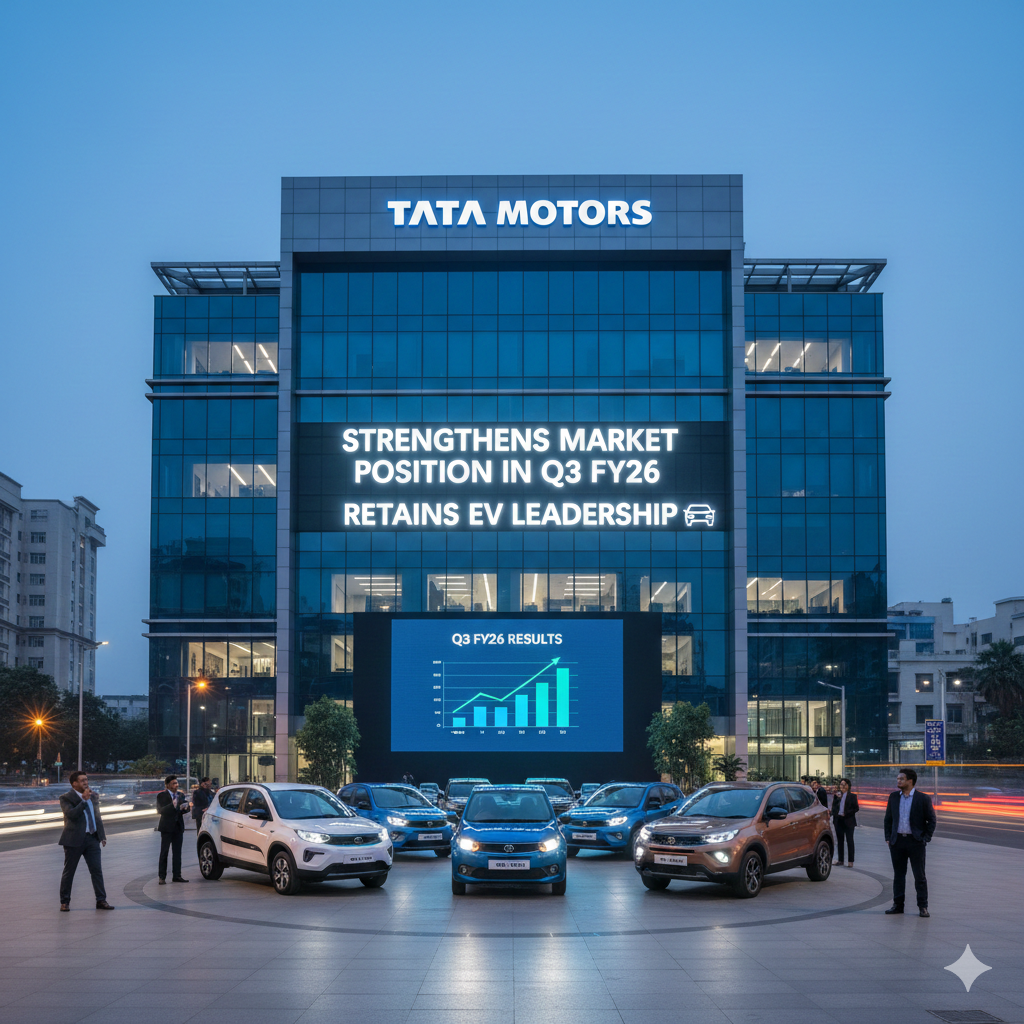
Tata Motors continued its strong performance in India’s passenger vehicle market in the third quarter of FY26, reinforcing its position as one of the country’s leading automakers. The company recorded steady gains in overall market share while maintaining its dominance in the fast-growing electric vehicle (EV) segment.
Market Share Rises in Passenger Vehicle Segment
According to Vahan registration data, Tata Motors’ market share in the domestic passenger vehicle space increased to 13.8 per cent in Q3 FY26. This marked a rise of 100 basis points compared to the previous quarter, reflecting improved sales momentum and strong customer demand.
With this performance, Tata Motors secured the second position in India’s passenger vehicle market during the quarter, highlighting its growing competitiveness against established rivals.
The growth was driven by consistent demand for popular models such as the Nexon, Punch, Tiago and Harrier, along with newer offerings that have strengthened the company’s portfolio across multiple segments.
Continued Dominance in the EV Market
In the electric vehicle segment, Tata Motors retained its leadership position with a commanding market share of 43.6 per cent in Q3 FY26. The strong showing was supported by the company’s highest-ever quarterly EV registrations, underlining the sustained acceptance of its electric models among Indian buyers.
Tata’s EV lineup, which includes the Nexon EV, Tiago EV, Tigor EV and Punch EV, continues to attract customers with competitive pricing, expanding charging infrastructure and improving battery technology.
Industry analysts note that Tata’s early-mover advantage and focused investments in electric mobility have helped it build strong brand trust in the EV space.
Product Strategy and Ecosystem Support
A key factor behind Tata Motors’ performance has been its balanced product strategy, combining high-volume internal combustion engine (ICE) models with a rapidly expanding EV portfolio. This dual approach has allowed the company to cater to diverse customer needs while staying aligned with India’s electrification goals.
In addition, Tata Motors has benefited from the wider Tata Group ecosystem, including Tata Power’s charging network and Tata Chemicals’ battery-related initiatives. This integrated approach has helped address key concerns such as range anxiety and charging accessibility.
Focus on Technology and Safety
The automaker has also continued to emphasise safety, technology and design across its lineup. Many Tata models have received high safety ratings, which has enhanced their appeal among urban and family buyers.
Features such as connected car technology, advanced infotainment systems and improved powertrain options have further strengthened the company’s market positioning.
Outlook for the Coming Quarters
With rising demand for EVs, increasing consumer preference for safer vehicles and a strong pipeline of upcoming models, Tata Motors is well placed to sustain its growth momentum in the coming quarters.
The company is expected to further expand its electric portfolio and improve localisation levels, which could help it maintain pricing competitiveness and profitability.
As India’s passenger vehicle market continues to evolve, Tata Motors’ strong performance in Q3 FY26 and its leadership in electric mobility underline its role as a key driver of the country’s automotive transformation.