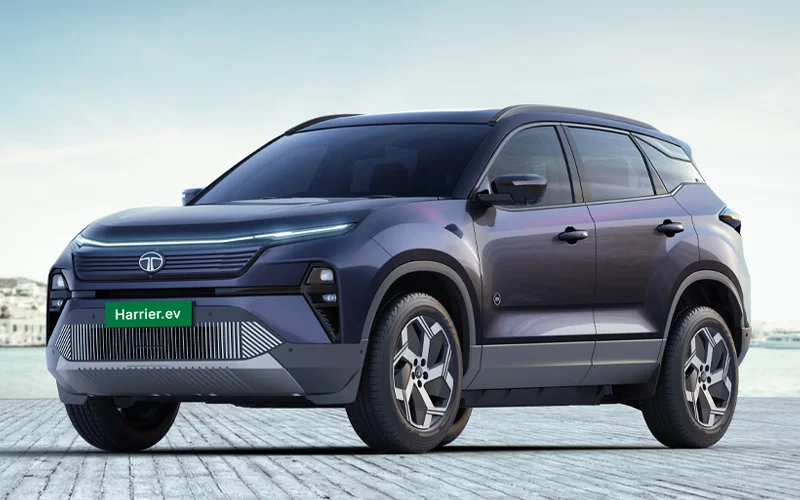
In a pivotal moment for India’s electric vehicle landscape, Tata Motors’ electric vehicle (EV) division has marked a significant milestone. The Harrier.ev, launched in June 2025, has surged ahead to claim the title of the company’s best-selling electric SUV, eclipsing the longstanding leader, the Nexon.ev. This shift, first observed in November 2025, signals a maturing portfolio where premium offerings are driving volume growth amid intensifying competition.
Recent data from industry trackers highlights the Harrier.evs’ breakout performance. In November 2025, it recorded 2,458 unit sales, narrowly outpacing the Nexon.ev’s 2,230 units. This marked the first time the newer model overtook its compact sibling in monthly dispatches, aligning with a broader upward trajectory for Tata’s EV volumes. Through the latter half of 2025, the Harrier.ev has consistently emerged as the top contributor to the brand’s electric sales, helping Tata achieve back-to-back monthly records. For context, Tata’s overall EV wholesales hit 7,911 units in November, a robust 52% year-on-year increase, with the Harrier.ev playing a starring role in this momentum.
This sales inversion is particularly noteworthy given the Nexon.evs’ storied dominance. Since its 2019 debut, the compact SUV has been Tata’s EV volume powerhouse, often accounting for over 40% of the company’s electric sales. Cumulative Nexon.ev figures have surpassed 80,000 units, underscoring its mass-market appeal. However, the Harrier.evs’ rise reflects evolving buyer preferences: consumers are increasingly drawn to larger, more feature-laden EVs that blend luxury with practicality. While the Nexon.ev remains a bestseller in the broader Nexon lineup—total Nexon dispatches, including ICE variants, topped 22,000 units in November—the Harrier.evs’ standalone success points to a premiumization trend in Tata’s EV strategy.
Positioned as the flagship in Tata’s electric SUV stable, the Harrier.ev occupies a more upscale niche than the entry-premium Nexon.ev. Priced between Rs 21.49 lakh and Rs 30.23 lakh (ex-showroom), it targets buyers seeking a sophisticated alternative to traditional internal combustion engine (ICE) midsize SUVs. Built on the advanced Acti.ev Gen 2 architecture—a scalable platform derived from Tata’s proven Omega-Arc framework—the Harrier.ev introduces cutting-edge EV-specific innovations.
At its core, the Harrier.ev offers two battery options: a 65 kWh pack for rear-wheel-drive (RWD) configurations, delivering a certified range of 538 km, and a larger 75 kWh unit that extends to 627 km. Real-world estimates hover between 480-505 km, making it one of the longest-range EVs in its class. Powertrains include a single-motor RWD setup producing 238 PS and 315 Nm, ideal for urban efficiency, or a dual-motor all-wheel-drive (AWD) variant—branded as Quad Wheel Drive (QWD)—that unleashes 390 PS and 504 Nm for spirited performance. Acceleration from 0-100 kmph clocks in at around 6.3 seconds in the top spec, with six terrain modes (Normal, Rock Crawl, Mud Ruts, Snow & Grass, Sand, and Custom) enabling confident off-road ventures.
Charging is equally forward-thinking. A 7.2 kW AC wallbox takes 9-10 hours for a full top-up, while a 120 kW DC fast charger adds 250 km in just 15 minutes. Unique features like Vehicle-to-Load (V2L) at 3.3 kW and Vehicle-to-Vehicle (V2V) at 5 kW transform the SUV into a mobile power bank, perfect for camping or emergencies. Inside, a Qualcomm Snapdragon-powered infotainment system anchors a tech-rich cabin with a 12.3-inch touchscreen, 10.25-inch digital driver’s display, dual-zone climate control, and ADAS suite including adaptive cruise control and lane-keeping assist. Safety is paramount, with a 5-star Bharat NCAP rating across adult and child protection metrics.
The Harrier.evs’ appeal extends beyond specs. Its design echoes the ICE Harrier’s muscular stance—bold LED projector headlamps, a sealed aero-optimized grille, and 19-inch alloys—while EV tweaks like a Stealth Edition in all-black enhance its road presence. Available in four colors (Nainital Nocturne, Empowered Oxide, Pure Grey, Pristine White), it boasts a spacious five-seater layout with ventilated seats, a panoramic sunroof, and a 460-liter boot. AWD variants, surprisingly, account for 30% of sales—far exceeding the low single-digits typical for ICE 4x4s—driven by demand for its 505 Nm torque and terrain prowess.
This sales shift arrives at a transformative time for Tata Motors. The company’s EV penetration reached 14% of total passenger vehicle sales in the first 10 months of 2025, up from 12% the prior year, with cumulative dispatches nearing 66,000 units. Yet, challenges persist: Tata’s market share has dipped to 40% from a peak of 65%, as rivals like Mahindra (XEV 9e) and JSW MG (Windsor EV) erode ground. Overall passenger vehicle sales grew 26% year-on-year to 59,199 units in November, but EV growth at 52% underscores the segment’s potential.
The Harrier.evs’ success—contributing to Harrier lineup totals of over 4,400 units in October—highlights Tata’s pivot toward premium EVs. It has boosted combined Harrier sales by 41% year-on-year through October, with 81% of volume in the last four months alone. Waiting periods stretch to two months for popular Adventure variants, signaling supply strains but also pent-up demand. Tata’s response includes expanding QWD to mid-spec trims and leveraging partnerships like Red Bull for visibility.
Looking ahead, Tata aims for one EV per five cars sold, with a 10-model lineup by FY2026, including the Sierra EV and Avinya series. The Harrier.evs’ ascent not only validates the Acti.ev platform but also positions Tata to capture the burgeoning premium EV market, where range, tech, and versatility trump mere affordability. As 2025 closes, this “new phase” feels like the dawn of Tata’s EV dominance reloaded—one electrified SUV at a time.
29 wb pages