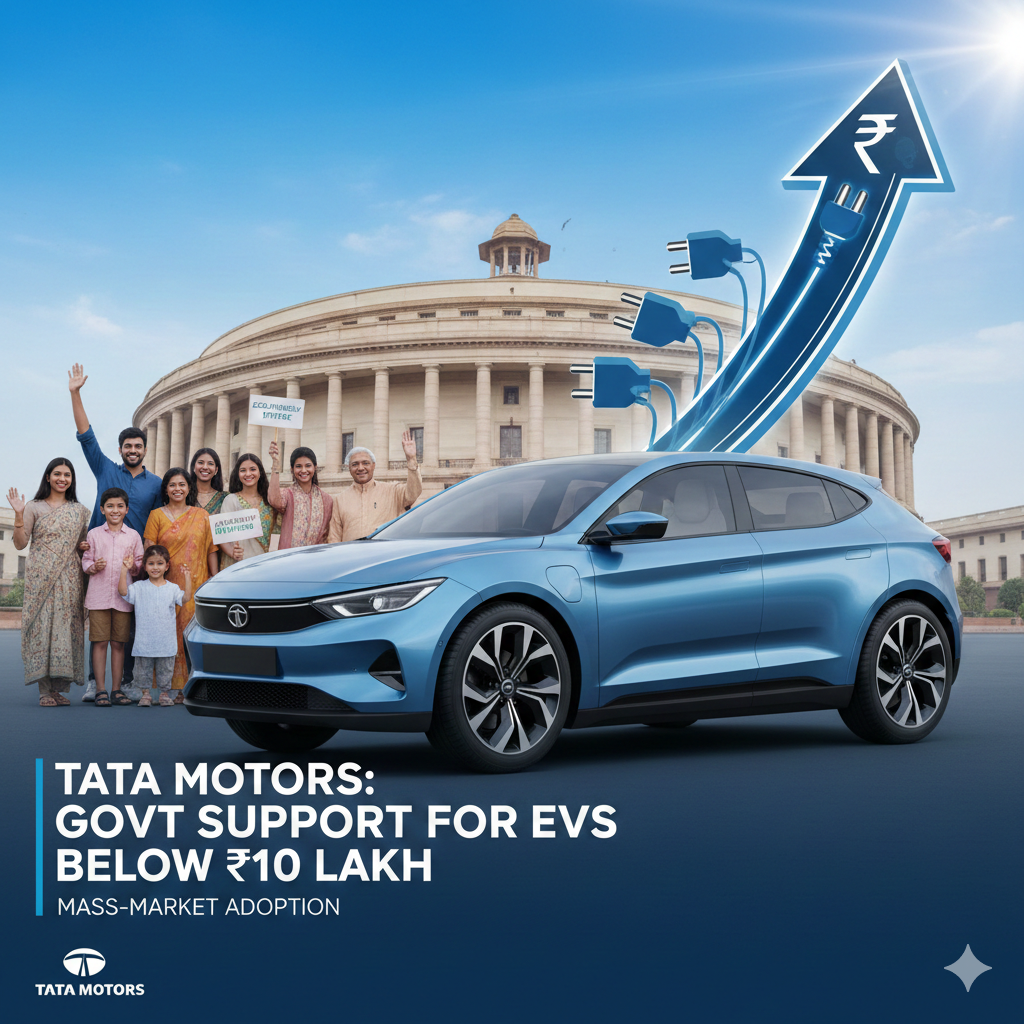
Tata Motors believes that sustained government support will be critical for electric cars priced under ₹10 lakh to achieve true mass-market adoption in India. The company has highlighted that this entry-level EV segment holds the key to accelerating the country’s transition to electric mobility but continues to face significant cost-related challenges.
Speaking on the issue, Shailesh Chandra, Managing Director and CEO of Tata Passenger Vehicles, said that scaling electric cars into the mass market will remain a difficult task unless targeted policy support is extended to e-cars in the sub-₹10-lakh bracket. According to him, this price band is essential for attracting first-time EV buyers and expanding adoption beyond early urban users, yet structural cost pressures make it difficult for manufacturers to offer competitive pricing without incentives.
Recent changes in the Goods and Services Tax (GST) regime have also had an impact on entry-level EV prices, making affordability an even bigger concern for customers. Tata Motors has indicated that while the overall EV ecosystem in India is maturing, supportive taxation and incentive structures remain vital, especially for smaller, more affordable electric cars.
Despite these challenges, Tata Motors reported strong sales growth in 2025, driven largely by rising acceptance of electric vehicles and steady demand for its existing EV portfolio. Building on this momentum, the company is preparing for an aggressive product push in 2026, with multiple new model launches planned across different segments. These upcoming models are expected to further strengthen Tata Motors’ position in India’s rapidly evolving EV market.
In addition to private buyers, Tata Motors has also emphasised the importance of incentivising electric fleet vehicles. According to the company, fleet electrification can deliver a disproportionately positive environmental impact due to higher daily usage and faster replacement of internal combustion engine vehicles. Targeted incentives for fleet operators could therefore play a crucial role in reducing urban emissions while also helping scale EV volumes.
Overall, Tata Motors maintains that a combination of focused government support for affordable electric cars, stable taxation policies and incentives for fleet electrification will be essential to unlock the next phase of EV growth in India and make electric mobility accessible to a much wider audience.