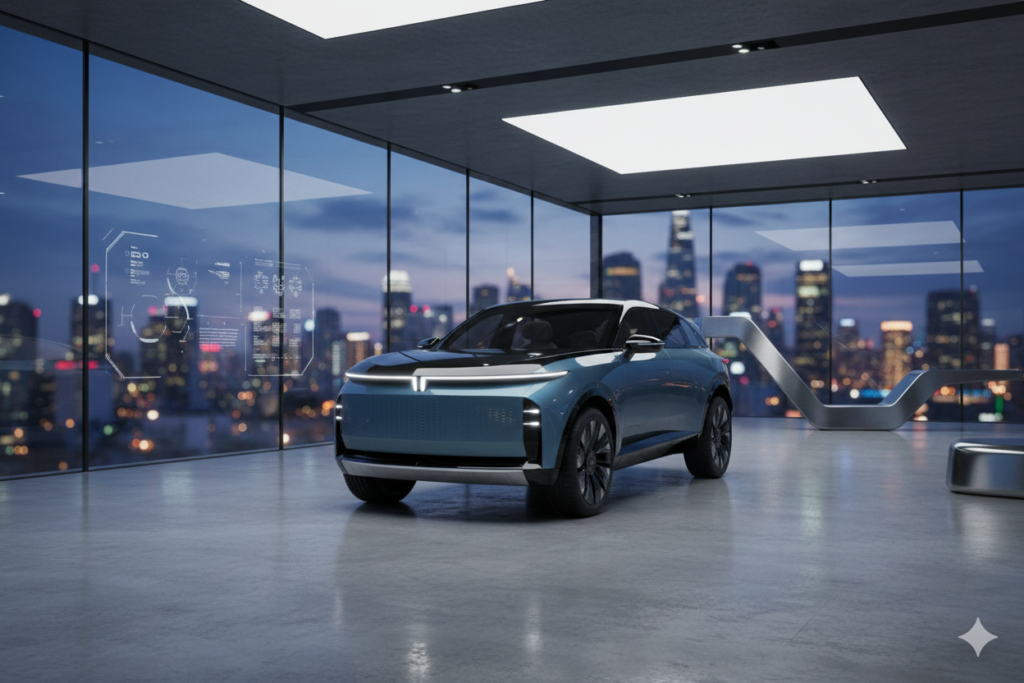
Tata Motors is gearing up to redefine its presence in the premium electric vehicle segment with the Avinya series. This ambitious lineup marks a significant departure from the company’s current EV offerings, which often adapt existing internal combustion engine (ICE) architectures. Instead, Avinya is built from the ground up as a dedicated, “born-electric” program, leveraging a strategic platform-sharing partnership with Jaguar Land Rover (JLR).
Tata Passenger Electric Mobility Ltd (TPEM) and JLR — both wholly owned subsidiaries of Tata Motors — signed a Memorandum of Understanding (MoU) to license JLR’s Electrified Modular Architecture (EMA) platform. This agreement includes access to critical components such as the electrical architecture, electric drive units, battery pack technology, and manufacturing know-how, all in exchange for a royalty fee.
Announced in late 2023 and reaffirmed in recent updates (including comments from Tata Motors Group CFO PB Balaji in December 2025), the collaboration allows Tata to fast-track development while ensuring global standards in efficiency, range, and performance. The EMA platform, originally designed for JLR’s next-generation pure-electric mid-size SUVs (set to debut internationally from 2025), is a true “born-electric” architecture. It was engineered specifically around high-voltage hardware from the outset, rather than retrofitting EV components into an ICE-derived structure.
This partnership represents a win-win: Tata gains advanced, proven technology to elevate its premium positioning, while JLR benefits from shared knowledge, potential cost synergies through localization, and expanded scale within the Tata Group ecosystem
Unlike Tata’s earlier EVs (which often adapt flexible or modified ICE platforms), the EMA-based Avinya is fundamentally designed for electrification. This “born-electric” approach delivers several key advantages:
- Flat floor design → Maximizes interior space by eliminating the traditional transmission tunnel.
- Optimized wheelbase and proportions → Allows for a longer wheelbase relative to overall length, improving cabin roominess and stability.
- Flexible placement of batteries and motors → Enables better weight distribution, lower center of gravity, and enhanced handling.
- Integrated high-voltage systems → Superior cooling, electronics, and propulsion efficiency, supporting ultra-fast charging and extended range.
These features align perfectly with the original Avinya concept, first unveiled in 2022, which emphasized a spacious, lounge-like cabin with easy access, minimalism, next-generation connectivity, advanced driver-assistance systems (ADAS), and a focus on well-being.
The result is not an EV version of an existing SUV — it’s a vehicle where electric architecture drives every design decision, promising class-leading interior comfort, refinement, and sustainability.
The Avinya name, derived from Sanskrit for “innovation,” embodies Tata’s vision for empathetic, future-focused mobility. The 2022 concept showcased a sleek, aerodynamic form with butterfly doors, sustainable materials, and a serene interior inspired by human-centric design.
Recent developments confirm that Avinya will spawn a family of models (potentially up to five, codenamed P1 through P5), starting with a sportback-style vehicle before expanding into SUVs of varying sizes — including mid-size options around 4.4 meters and larger luxury three-row variants.
Tata plans to localize the EMA platform extensively in India (likely at facilities in Sanand, Gujarat, and a new plant in Tamil Nadu) to balance premium quality with competitive pricing. This ensures Avinya sits above mainstream Tata EVs (like the Nexon.ev or upcoming Sierra.ev) while remaining accessible compared to full luxury imports.
The first Avinya model is now slated for launch by the end of 2026, following some timeline adjustments from earlier 2025 targets. This positions it as a flagship in Tata’s aggressive EV roadmap, backed by significant investments (₹16,000–18,000 crore over five years) and a separate premium sales experience.
By choosing JLR’s EMA over a complete in-house rework or adaptation of existing Tata architectures, Avinya stands as a bold statement: a truly dedicated electric future, where space, efficiency, and innovation take center stage. As India’s EV leader continues its global ambitions, this platform-sharing synergy could set new benchmarks for premium electric mobility — not just in India, but worldwide.