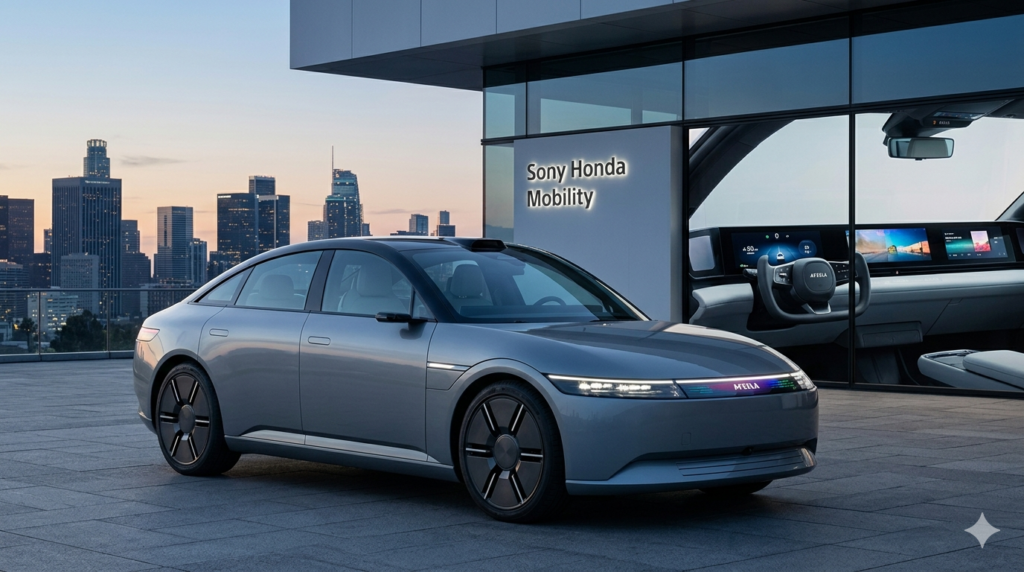
In a stunning development that has sent ripples across the automotive and technology worlds, Sony Honda Mobility (SHM) has officially announced the cancellation of its entire Afeela electric vehicle program. The high-profile joint venture between Sony and Honda will no longer bring the flagship Afeela 1 sedan or its planned SUV to market.
The announcement, made on March 25, 2026, marks the abrupt end of a project that was once hailed as a revolutionary “PlayStation on wheels” — promising immersive entertainment, advanced AI, and a completely reimagined in-cabin experience.
What Was the Afeela Project?
Launched with much fanfare at CES 2023, the Afeela 1 was envisioned as a premium electric sedan blending Honda’s automotive engineering expertise with Sony’s deep knowledge in electronics, gaming, sensors, and entertainment systems.Key highlights of the ambitious project included:
- Advanced AI and autonomous driving capabilities
- Immersive “private theater” interior with high-end audio-visual systems
- Integration of PlayStation-style gaming and entertainment features
- A sleek, futuristic design aimed at the North American market, with initial deliveries planned for California in late 2026
The base Afeela 1 was priced around $90,000, with the Signature variant reaching approximately $103,000. A second model — an SUV sharing the same battery-electric architecture — was also under development for a later launch.
Why the Afeela Project Was Cancelled
Sony Honda Mobility stated clearly that the decision stems directly from Honda’s major reassessment of its automobile electrification strategy, announced on March 12, 2026.As part of this strategic overhaul, Honda decided to cancel several planned EV models for the North American market. This shift left SHM unable to access critical technologies and assets originally promised by Honda, making the Afeela program unviable in its current form.Honda is reportedly taking a massive $15.7 billion (2.5 trillion yen) writedown related to its EV investments — marking its first annual loss in nearly 70 years as a listed company. Factors driving this painful pivot include:
- Softer-than-expected EV demand in key markets
- Policy changes in the United States (including shifts in tax incentives and emissions regulations)
- Intensifying competition, particularly from Chinese EV makers
- High development costs and weaker product appeal in certain regions
Without Honda’s foundational platform support, Sony Honda Mobility concluded it “does not have a viable path forward” to bring the Afeela models to market as originally planned.
What Happens Next?
- Refunds: All customers who paid reservation fees for the Afeela 1 will receive full refunds.
- Joint Venture Review: Sony and Honda will now re-evaluate the future direction of Sony Honda Mobility, including its mid-to-long-term positioning in the mobility space.
- The companies have stated that this decision will not have a material financial impact on either parent company.
Both firms have committed to announcing the revised future of the joint venture at the earliest opportunity.
The Bigger Picture: A Tough Time for Premium EVs
The cancellation of the Afeela project is the latest in a growing list of EV ambitions being scaled back or abandoned by traditional automakers and tech players alike. It highlights the harsh realities facing the industry: slowing EV adoption in some markets, massive capital requirements, and intense global competition.
For enthusiasts who were excited about the unique entertainment-focused vision of the “PlayStation Car,” this news is undoubtedly disappointing. The Afeela represented an ambitious attempt to merge gaming culture with mobility — a dream that, for now, will remain on the drawing board.
As Honda prepares to unveil its new business plan in May 2026, the industry will be watching closely to see how legacy automakers balance the transition to electrification with current market and policy headwinds.