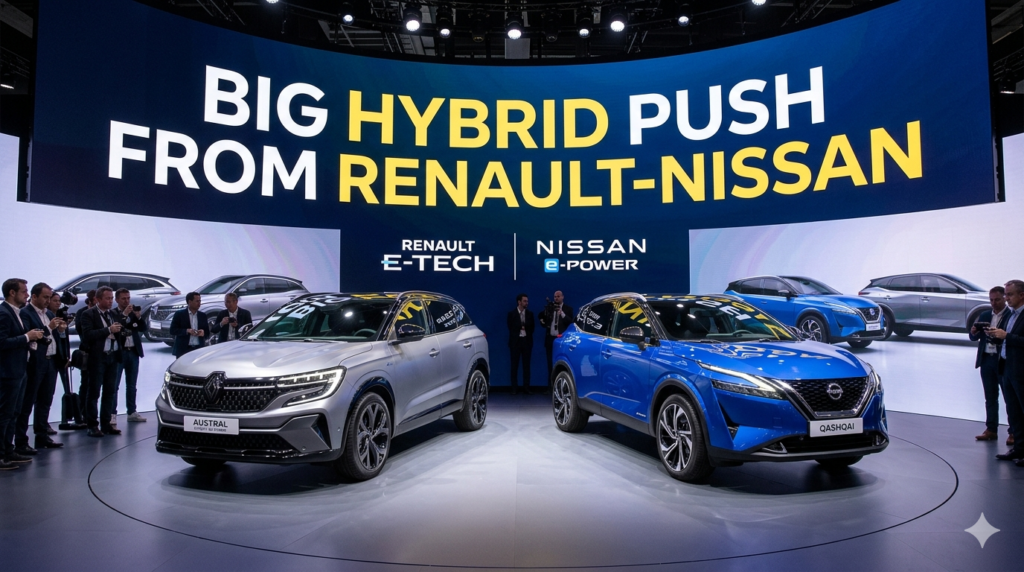
Renault and Nissan are gearing up for a significant comeback in the Indian market through their renewed alliance. The duo is focusing on a multi-pathway strategy that includes petrol, CNG, and hybrid powertrains to compete in high-volume segments. Hybrids form a key part of their plan to offer better fuel efficiency and lower running costs without jumping straight to full EVs in price-sensitive segments.
The alliance plans to launch multiple SUVs on shared platforms (like CMF-B), targeting compact to mid-size categories. These models will play the volume game by offering affordable pricing, strong localization, and a mix of conventional and electrified options. Most upcoming products are expected to include hybrid variants (mild-hybrid or strong/full hybrid) alongside standard petrol engines, with launches phased from 2026 onward.Here is a list of six affordable hybrid SUVs expected from Renault and Nissan in India in the near future (primarily 2026–2028 timeframe). Details are based on current reports, spy shots, and official hints—note that exact specs, pricing, and hybrid system details may evolve closer to launch:
1.Renault Duster (New Generation)
- Segment: Compact/mid-size SUV (around 4.3m length).
- Expected Launch: Early to mid-2026 (possibly January or around Diwali 2025 window in some reports).
- Hybrid Details: Strong hybrid powertrain planned (potentially combining a 1.8L petrol with electric motor for excellent efficiency; claims of up to 1,000 km range in some international/early speculation). Mild-hybrid options (48V) with turbo-petrol engines are also likely at launch.
- Key Highlights: Modern design with Y-shaped LED DRLs, 10.1-inch touchscreen, advanced safety (AEB, lane keep), and AWD availability in select variants. It will rival models like the Hyundai Creta.
- Positioning: Core volume player with hybrid for better mileage in competitive segment.
2.Nissan Tekton
Positioning: Nissan-badged sibling to Duster, targeting Creta/Seltos rivals with hybrid efficiency for volume sales.
Segment: Mid-size 5-seater C-SUV.
Expected Launch: Around June 2026.
Hybrid Details: Shares platform and powertrains with the new Duster, so expect mild-hybrid turbo-petrol initially, followed by a strong hybrid version (similar to Duster’s setup).
Key Highlights: More aggressive styling with connected DRLs/tail lights and bold design elements. Same engines as Duster (1.0L/1.2L/1.3L turbo-petrol options).
3.Renault Bigster
Positioning: Affordable yet premium-feeling option in the 12+ lakh range, with hybrids to appeal to efficiency-conscious buyers.
Segment: Mid-size SUV (slightly larger than Duster).
Expected Launch: Mid-2026.
Hybrid Details: Mild-hybrid and strong hybrid powertrain options (similar to Duster; petrol engines with hybrid assistance for improved efficiency and potential AWD).
Key Highlights: Butch design inspired by Duster concepts, updated interior with large infotainment, and family-friendly space.
4.Nissan 7-Seater C-SUV (Duster-based)
Positioning: Family-oriented volume model to compete in the 7-seater SUV space with hybrid as a differentiator.
Segment: 7-seater mid-size SUV.
Expected Launch: Early 2027.
Hybrid Details: Expected to inherit hybrid options from the Duster platform, including strong hybrid for better fuel economy in a larger vehicle.
Key Highlights: Unique styling from the 5-seater Tekton, more spacious third row, and shared tech/features.
5.Renault Bridger (Baby Duster / Sub-4m SUV)
- Segment: Sub-4m compact SUV.
- Expected Launch: 2027.
- Hybrid Details: Hybrid powertrain (strong hybrid or ET-tech full hybrid) alongside regular petrol engines; also mentions of EV variant.
- Key Highlights: More affordable and butch “mini Duster” styling for price-conscious buyers, with practical features.
- Positioning: Entry-level hybrid SUV to capture high-volume sub-4m segment with low running costs.
6. Renault Boreal (or Large 3-Row SUV)
Positioning: Higher-volume family SUV with hybrid variants to offer a balanced alternative to pure petrol or diesel rivals.
Segment: Larger three-row SUV.
Expected Launch: By end of 2026 or early 2027.
Hybrid Details: Multi-pathway approach includes hybrid options (likely mild or strong hybrid on petrol base) for efficiency in a bigger vehicle.
Key Highlights: Spacious family hauler with premium features and modern design.
These models reflect the alliance’s strategy of platform sharing to keep costs low while offering hybrid technology for better mileage (potentially 20–25+ kmpl in hybrid modes) and compliance with future emission norms. Initial launches may focus on petrol/CNG, with hybrid versions following shortly after (e.g., Duster hybrid by early 2027). Pricing is expected to remain competitive—starting from around ₹10–12 lakh for base models, with hybrids commanding a modest premium.
The focus on hybrids allows Renault and Nissan to play in multiple fuel segments without heavy EV infrastructure dependence initially, while building toward a stronger long-term presence. Actual details will become clearer as prototypes are tested and official announcements are made. Keep an eye on updates from Renault India and Nissan Motor India for confirmed specs and prices.