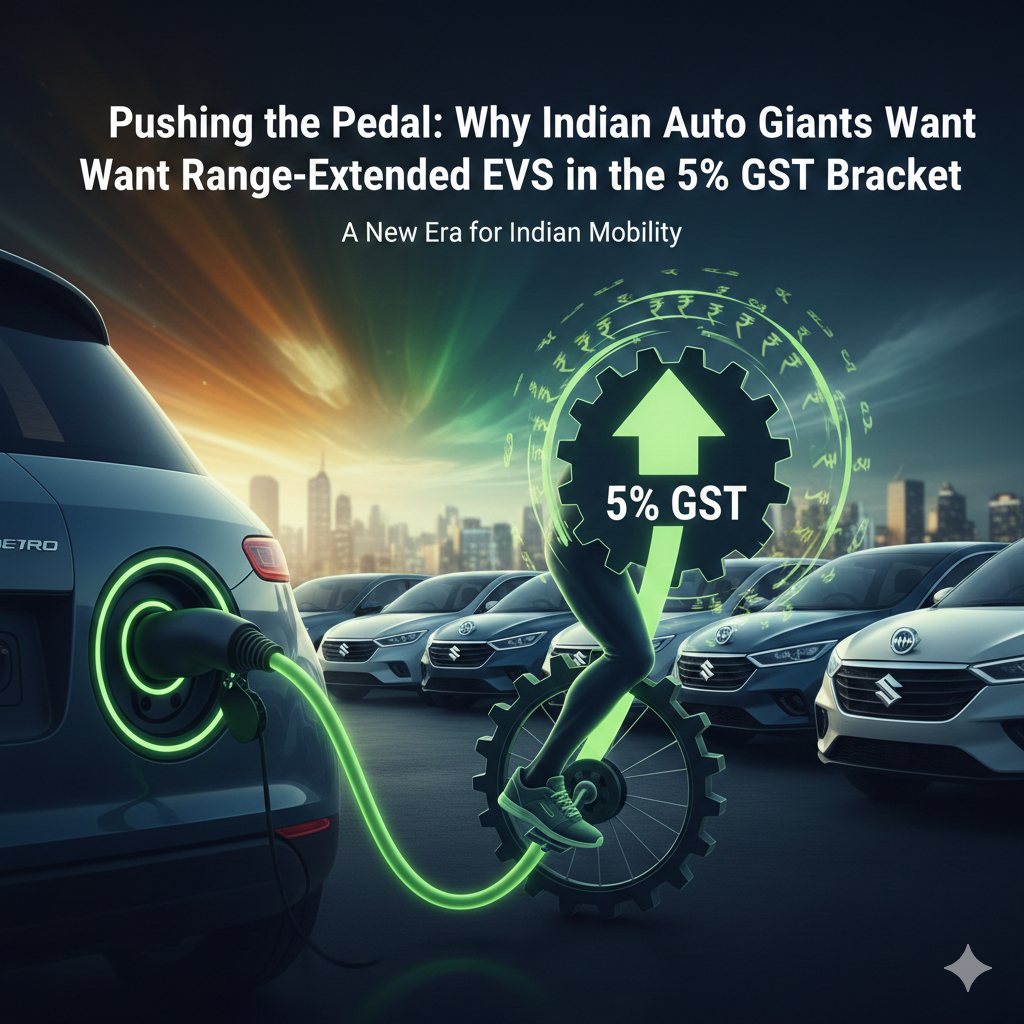
In a bid to electrify India’s roads faster and more affordably, leading automobile companies are intensifying their lobbying efforts with the government. Their target? Securing the lowest goods and services tax (GST) slab of 5% for range-extended electric vehicles (REEVs)—a hybrid innovation that’s part electric dream, part fossil fuel safety net. As the nation races toward its ambitious EV adoption goals, this push could redefine how we classify and incentivize the next wave of green mobility.
The Current GST Hurdle: A Tax Trap for Hybrids
India’s GST framework, revised to promote cleaner transport, currently favors pure electrics. Vehicles powered solely by electricity or hydrogen enjoy a mere 5% GST, making them an attractive buy for eco-conscious consumers. In stark contrast, traditional hybrids—those that blend electric motors with petrol or diesel engines—face an 18% levy. Worse still, larger vehicles running on internal combustion engines (ICE), like SUVs and sedans fueled by diesel, petrol, or CNG, are slapped with a whopping 40% GST if they exceed certain size thresholds.This tiered structure has spurred EV sales but left hybrids in the dust, despite their role as a bridge technology for a charging infrastructure that’s still patchy outside major cities. Enter REEVs: a nuanced player in this game, blending EV efficiency with onboard fuel flexibility, yet teetering on the edge of higher tax brackets.
Demystifying REEVs: The Best of Both Worlds?
So, what exactly are REEVs? Short for Range-Extended Electric Vehicles, these aren’t your standard hybrids or plug-in hybrids. At their core, REEVs are battery-powered EVs with a twist: a compact internal combustion engine (usually gasoline-fired) that doesn’t directly drive the wheels. Instead, it acts as a generator, recharging the battery on the fly when external plugs are scarce. This setup slashes dependence on charging stations, ideal for India’s vast rural stretches and urban gridlock.
Performance-wise, REEVs punch above their weight. Depending on battery size, engine specs, and vehicle type, they can deliver an impressive 35 km per liter equivalent—far surpassing many hybrids. However, there’s a catch: REEVs tend to be bulkier beasts, often stretching beyond 4.5 meters in length to accommodate the motor, hefty battery, and auxiliary engine. Under current rules, this size could relegate them to the 40% GST slab, pricing them out of reach for the average buyer.
The technology’s legitimacy got a boost on September 25, 2025, when the Bureau of Energy Efficiency (BEE) released its draft Corporate Average Fuel Efficiency (CAFÉ) 3 standards. In a nod to innovation, the BEE placed REEVs on par with full EVs, recognizing their potential to meet stringent efficiency norms without compromising range anxiety.
The Case for 5% GST: Affordability Meets Emissions Goals
Industry voices are rallying behind this cause with data-driven urgency. Ranjan Nayak, CEO of JSW Motors, highlighted the classification conundrum in a recent interaction reported by Moneycontrol: “Although REEVs are electric-driven vehicles, ambiguity in GST classification risks placing them under higher tax slabs, undermining affordability. The government must classify REEVs under the 5% GST rate.” Nayak’s plea underscores a broader fear: without tax relief, REEVs could remain niche imports rather than mass-market staples.Leading the charge is the Associated Chambers of Commerce and Industry of India (Assocham), which fired off a letter to the Ministry of Heavy Industries on Nov
ember 18, 2025. Assocham argues that REEVs’ emission profiles mirror those of pure EVs under real-world driving—about 70% cleaner than traditional ICE vehicles. This low-carbon footprint aligns seamlessly with India’s net-zero ambitions by 2070, making the 5% slab not just fair, but essential.
Globally, REEVs are no longer a lab experiment. China, the world’s EV powerhouse, has seen their market share explode from 4% in 2021 to 13% today, with projections hitting 16% by 2030. This surge persists even in a country blanketed by charging networks, proving consumers crave the freedom from plug dependency. European and American giants like Volkswagen and Stellantis are now eyeing REEVs as a turbocharge for EV penetration, blending compliance with customer appeal.
India’s Crossroads: A Make-or-Break Moment for Auto Innovation
The stakes couldn’t be higher for India’s auto sector. With global players scouting entry points amid tightening emission regs, the government’s stance on REEV taxation could swing the door wide open—or slam it shut. A 5% GST nod would democratize access, potentially flooding roads with vehicles that ease the EV transition without stranding drivers mid-journey. It would also signal India’s readiness to lead in pragmatic green tech, not just chase battery-only ideals.As deliberations heat up in New Delhi, one thing’s clear: ignoring REEVs risks ceding ground to competitors. By folding them into the 5% club, India could accelerate its electric revolution, one extended range at a time. Will policymakers listen? The road ahead depends on it.