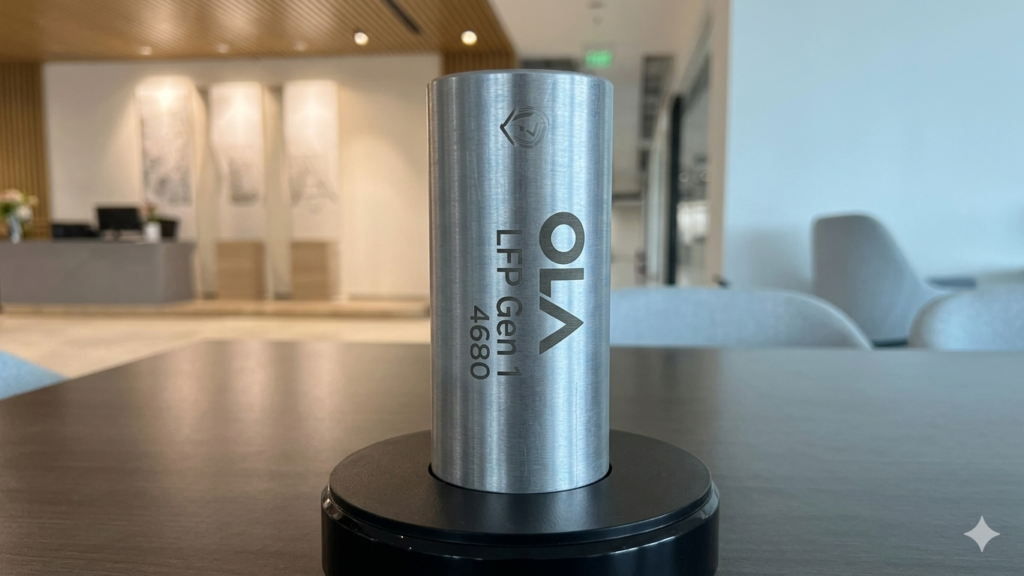
Ola Electric Mobility Ltd. has announced a significant milestone in its battery technology journey. On April 7, 2026, the company revealed that its in-house developed Lithium Iron Phosphate (LFP) battery cell in the 46100 cylindrical format is ready for commercial deployment.
The new LFP cells, larger than Ola’s current NMC-based 4680 “Bharat Cells,” will begin entering the company’s electric vehicles and energy storage products starting next quarter (likely Q2 FY27, around July–September 2026). This move marks a strategic shift from Nickel Manganese Cobalt (NMC) chemistry and aligns with Ola’s push for greater affordability, safety, and scalability in India’s EV market.
Ola’s Gigafactory in Tamil Nadu, currently at 2.5 GWh capacity and scaling toward 6 GWh, supports this expansion. Thousands of vehicles equipped with Ola’s earlier Bharat Cells have already accumulated millions of kilometers on Indian roads, providing real-world data for further optimization.
Founder and CMD Bhavish Aggarwal described the LFP cell as a “big unlock,” highlighting its potential to reduce vehicle costs, accelerate EV adoption, and serve as the foundation for battery storage solutions.
LFP chemistry is particularly well-suited for India’s hot climate and price-sensitive mass market. It promises:
- Lower production costs due to abundant, less volatile raw materials (iron and phosphate instead of nickel and cobalt).
- Enhanced safety and thermal stability.
- Longer lifespan.
This transition supports Ola’s “End ICE Age” vision by making electric scooters, motorcycles, and potentially three-wheelers more affordable while enabling energy storage applications.
Both LFP (LiFePO₄) and NMC (Lithium Nickel Manganese Cobalt Oxide) are lithium-ion battery chemistries, but they differ significantly in cathode materials, performance characteristics, and ideal use cases. Here’s a clear comparison:
1. Energy Density and Range
NMC batteries offer higher energy density (typically 150–260 Wh/kg), allowing for more compact, lighter battery packs that deliver greater driving range in the same space or weight. This makes NMC popular for premium or long-range EVs.
LFP batteries have lower energy density (around 90–160 Wh/kg), often resulting in slightly heavier packs or modestly reduced range for a given pack size. However, the larger 46100 format at Ola aims to help mitigate this through improved packaging and scale
2. Safety and Thermal Stability
LFP is widely regarded as safer. It has a higher thermal runaway temperature (around 500°C or more) and is far less prone to catching fire or exploding under stress, overheating, or damage. This is especially advantageous in India’s high ambient temperatures.
NMC batteries, while safe with proper management systems, have a lower thermal stability threshold and can pose higher risks in extreme conditions due to the reactive nature of nickel and cobalt.
3. Cycle Life and Longevity
LFP batteries excel in durability, often delivering 3,000–6,000+ charge-discharge cycles (potentially lasting 10+ years with minimal degradation). They tolerate full 100% charges better without significant wear.
NMC typically offers 800–2,000 cycles (3–8 years in typical EV use), with faster degradation if not managed carefully (e.g., avoiding frequent 100% charges or deep discharges).
4. Cost and Material Availability
LFP is significantly cheaper to produce because it uses abundant iron and phosphate—no expensive or ethically/ environmentally sensitive cobalt or high nickel content. This reduces supply chain risks and overall battery cost, directly translating to lower EV prices.
NMC relies on nickel, manganese, and cobalt, whose prices fluctuate and raise concerns around mining ethics, environmental impact, and geopolitical supply issues.
5. Charging and Performance
NMC generally supports faster charging and higher power output, making it suitable for performance-oriented vehicles.
LFP charges safely and efficiently but may have slightly slower peak charging rates in some scenarios. It performs well in high-temperature environments and supports high discharge rates for applications like energy storage.
6. Environmental and Sustainability Impact
LFP has a lower carbon footprint, easier recyclability, and avoids controversial cobalt mining. It is often viewed as more sustainable for mass adoption.
NMC has higher environmental costs due to mining and processing of nickel and cobalt, though recycling technologies are improving.
Summary Table: LFP vs NMC at a Glance
- Energy Density: LFP Lower | NMC Higher (better range/compactness)
- Safety: LFP Excellent (high thermal stability) | NMC Good (requires robust BMS)
- Cycle Life: LFP 3,000–6,000+ cycles | NMC 800–2,000 cycles
- Cost: LFP Lower (abundant materials) | NMC Higher (cobalt/nickel)
- Best For: LFP Mass-market EVs, hot climates, energy storage | NMC Premium/long-range EVs, high-performance needs
- Voltage: LFP ~3.2V nominal | NMC ~3.6–3.7V
By adopting LFP, Ola aims to make its scooters and other products more affordable without compromising core reliability and safety—critical factors for widespread two-wheeler EV adoption in India. The shift could also enable competitive pricing against internal combustion engine (ICE) vehicles while supporting Ola’s broader energy ecosystem ambitions, including stationary storage.
This development comes as Ola continues scaling its Gigafactory and leveraging real-world data from its existing NMC cells. While NMC may continue in select high-performance variants, LFP is positioned as the workhorse for volume-driven, cost-sensitive segments.
Overall, Ola’s move to in-house LFP production strengthens India’s push toward self-reliant EV manufacturing and could accelerate the transition away from fossil fuels by making electric mobility more accessible and sustainable.
As the next quarter approaches, EV enthusiasts and industry watchers will be keen to see how the new 46100 LFP cells perform in real-world Ola products and whether they deliver the promised cost reductions and reliability gains