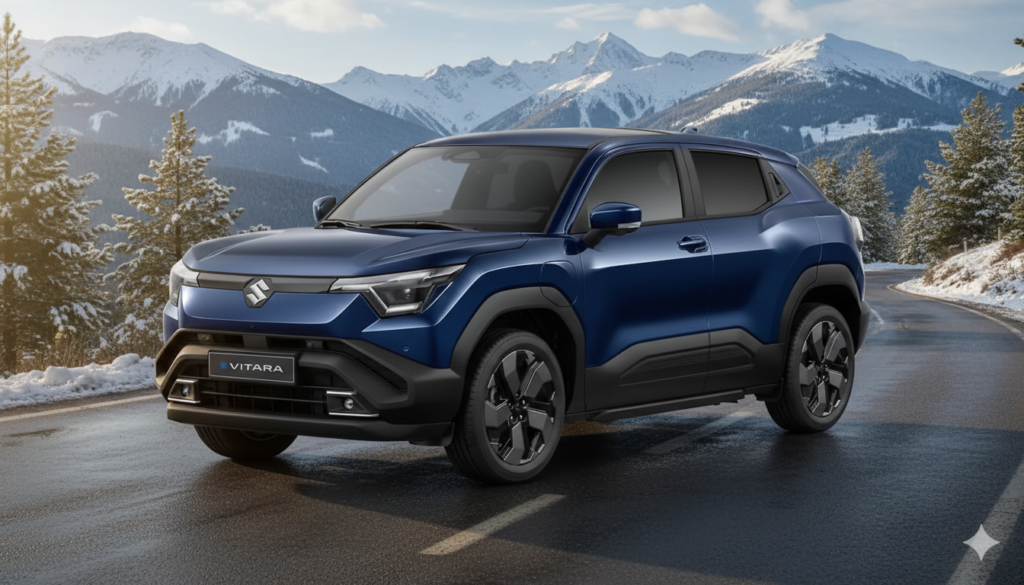
India’s mass-market electric SUV segment is witnessing a quiet but significant transformation, led by Maruti Suzuki and its upcoming eVitara. Even before its official retail debut in the domestic market, the company has crossed 16,000 units in exports—making it one of the most important EV developments in the segment so far.
This milestone signals that the eVitara is not a symbolic or experimental electric model. Instead, it reflects a well-planned, export-driven production programme that is already operating at scale.
Export-First Strategy Takes Shape
Maruti’s eVitara production has been geared primarily towards overseas markets since shipments began in August 2025. Large volumes are being sent to regions such as Europe and Japan, where demand for compact electric SUVs remains strong and regulatory pressures are accelerating EV adoption.
While international customers are already receiving deliveries, Indian buyers are still awaiting official details on pricing, bookings, and launch timelines. This unusual sequence highlights Maruti’s strategy of establishing global credibility and volume stability before rolling out the product locally.
Steady Growth, Not a One-Time Spike
The latest export figure also aligns closely with the company’s earlier update from January 2026, when it reported more than 13,000 units shipped overseas. Crossing the 16,000 mark shortly after indicates a consistent production ramp-up rather than a temporary dispatch surge.
Industry analysts see this as evidence of:
- Stable manufacturing capacity
- Strong international order pipelines
- Growing confidence from global distributors
Such consistency is crucial for EV programmes, where supply chain disruptions and battery availability often slow down scaling efforts.
Why This Matters for India’s EV Market
Maruti’s export success with the eVitara carries major implications for the domestic electric vehicle landscape. Historically, the company has dominated India’s mass-market segments, and its serious entry into EVs could reshape competition.
By proving the eVitara’s viability in mature EV markets first, Maruti is reducing risks associated with quality, performance, and long-term reliability. When the model finally launches in India, it is likely to arrive as a globally validated product rather than an untested newcomer.
This approach contrasts with many earlier EV launches that focused primarily on domestic pilots before expanding internationally.
Waiting Game for Indian Buyers
Despite the positive export momentum, uncertainty remains for Indian customers. Pricing clarity, booking windows, and dealership readiness are yet to be announced. Given Maruti’s strong brand presence, expectations are high that the eVitara will be positioned aggressively to attract first-time EV buyers.
However, the company appears focused on ensuring production stability and international commitments before shifting full attention to the home market.
Long-Term Strategic Play
The export-led success of the eVitara underlines Maruti’s broader EV strategy: build scale first, establish reliability, and then target mass adoption. This method reduces financial risk and strengthens the company’s bargaining power in battery sourcing and component procurement.
As global volumes increase, Maruti can also benefit from cost efficiencies, potentially enabling more competitive pricing in India later.
Conclusion
Crossing 16,000 eVitara exports ahead of its domestic launch marks a turning point in India’s electric SUV journey. It confirms that Maruti’s EV ambitions are grounded in scale, planning, and long-term commitment—not short-term experimentation.
When the eVitara finally reaches Indian showrooms, it will do so with a proven global track record, setting the stage for a new chapter in the country’s mass-market EV revolution.