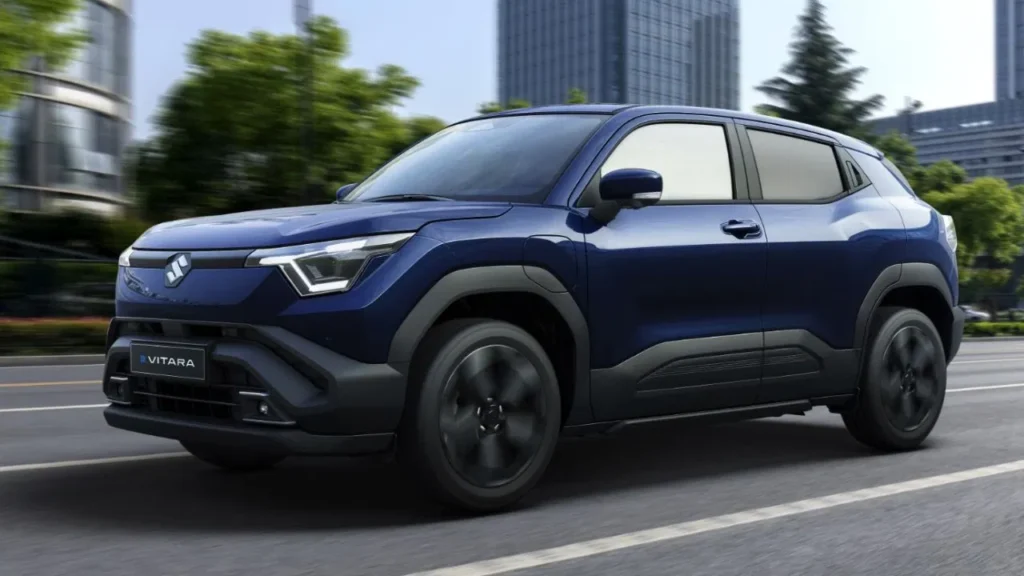
In a bold stride toward electrifying India’s roads, Maruti Suzuki India Limited (MSIL) is on the cusp of unveiling its first fully electric vehicle, the e Vitara, slated for a December launch. This midsize SUV represents the Japanese automaker’s long-awaited foray into the battery electric vehicle (BEV) arena, a segment where it has lagged behind rivals like Tata Motors and Mahindra. The announcement, delivered with characteristic precision, signals Maruti’s confidence in capturing a slice of the rapidly expanding EV pie, even as the market navigates subsidy uncertainties.
Hisashi Takeuchi, Managing Director and CEO of Maruti Suzuki, confirmed the timeline during a media briefing on the company’s financial performance for the first half of FY26 (April-September 2025). Amid robust sales figures—total dispatches crossed 10 lakh units in the period—Takeuchi highlighted the e Vitara as a cornerstone of Maruti’s green mobility strategy. “We’re not just entering the EV space; we’re doing it with a vehicle that’s already proven its mettle globally,” he remarked, alluding to the model’s international rollout.
From Delays to Delivery: A Gujarat-Made Global Contender
The e Vitara’s path to market hasn’t been without bumps. Production at Maruti’s state-of-the-art Hansalpur plant in Gujarat kicked off earlier this year, but the domestic launch faced multiple postponements due to snags in battery procurement and software integration. What was initially pegged for a mid-2025 reveal, complete with pricing details, has now crystallized into a year-end event. These hurdles, common in the nascent EV ecosystem, underscore the complexities of scaling electric tech in a supply-chain-sensitive environment.
Yet, the delays haven’t dimmed the model’s export prowess. Since shipments began in August 2025, over 7,000 units have been dispatched to international shores, with the United Kingdom emerging as the frontrunner buyer. The made-in-India e Vitara is now gracing showrooms in more than 100 countries, with a strong European footprint. Key markets include Germany, Norway, France, Denmark, Switzerland, Netherlands, Sweden, Hungary, Iceland, Austria, and Belgium—regions where stringent emission norms and generous incentives have fueled EV adoption.
This export momentum is no small feat for Maruti, which has historically dominated India’s internal combustion engine (ICE) space with over 40% market share. The e Vitara, co-developed with Suzuki’s global R&D teams and Toyota (via their alliance), leverages the Vitara’s familiar silhouette but swaps the engine for a whisper-quiet electric heart. Priced competitively in export markets—starting around £35,000 (approx. ₹38 lakh) in the UK—it has garnered praise for its blend of Japanese reliability and Indian value engineering.
Powertrain and Performance: Tailored for Indian Roads
Debuting in India with a single powertrain configuration, the e Vitara prioritizes accessibility and range anxiety mitigation. The initial variant packs a 61 kWh lithium-ion battery, mated to a front-wheel-drive (FWD) setup, delivering over 500 kilometers of real-world range on a single charge, as certified by the Automotive Research Association of India (ARAI). This figure positions it favorably against competitors like the Tata Nexon EV (around 465 km) and MG ZS EV (461 km), making it ideal for inter-city jaunts in a country where highway charging is still evolving.
Under the hood—or rather, the floorpan—the 61 kWh unit drives a single electric motor churning out 174 horsepower and 192.5 Newton-meters of torque. Acceleration from 0-100 km/h clocks in under 9 seconds, with a top speed hovering around 160 km/h. Maruti promises ultra-fast charging capabilities, with a 30-minute top-up from 20-80% using a 50 kW DC charger, thanks to advanced battery management systems.
For context, international versions offer more variety. The entry-level 49 kWh battery powers a 144 hp motor with the same 192.5 Nm torque, suiting urban commuters with a sub-400 km range. The hero spec, however, is the 61 kWh all-wheel-drive (AWD) model, which adds a rear-axle motor for a combined 184 hp. This dual-motor variant enhances traction on slippery terrains, appealing to adventure seekers in Europe’s rugged landscapes. While the AWD e Vitara has already hit overseas lots, Indian buyers will have to wait for a subsequent rollout, likely in early 2026, as Maruti gauges demand for the FWD staple.
Safety and features remain on-brand: Expect a suite of ADAS Level 2 tech, including adaptive cruise control and lane-keeping assist, alongside a 10.25-inch infotainment screen, panoramic sunroof, and vegan leather upholstery. The Gujarat facility, with its 1.2 million annual capacity for EVs, ensures scalability, with Maruti eyeing 50,000 units in the first full year.
Broader Implications: Maruti’s EV Ambitions in a Shifting Landscape
The e Vitara’s arrival couldn’t be timelier. With the government’s EV subsidies potentially phasing out—as hinted by Ministry of Heavy Industries officials last month—Maruti’s timing reflects a bet on organic growth. The company, part of Suzuki Motor Corporation, plans to electrify 15% of its portfolio by 2030, backed by investments exceeding ₹10,000 crore in EV infrastructure. Collaborations with Toyota for battery tech and Gujarat’s renewable energy grid will be pivotal.Analysts are bullish. “Maruti’s volume expertise could disrupt the premium EV segment,” notes Vinay Piparda, an auto sector expert at Elara Securities. Exports, already contributing 15% to Maruti’s revenue, could swell further, bolstering forex reserves while burnishing India’s EV export credentials.As December approaches, showrooms buzz with anticipation. The e Vitara isn’t just a vehicle; it’s Maruti’s manifesto for a electrified future—one charge at a time. For a nation racing toward net-zero, this Suzuki sibling might just be the spark that ignites mass adoption.