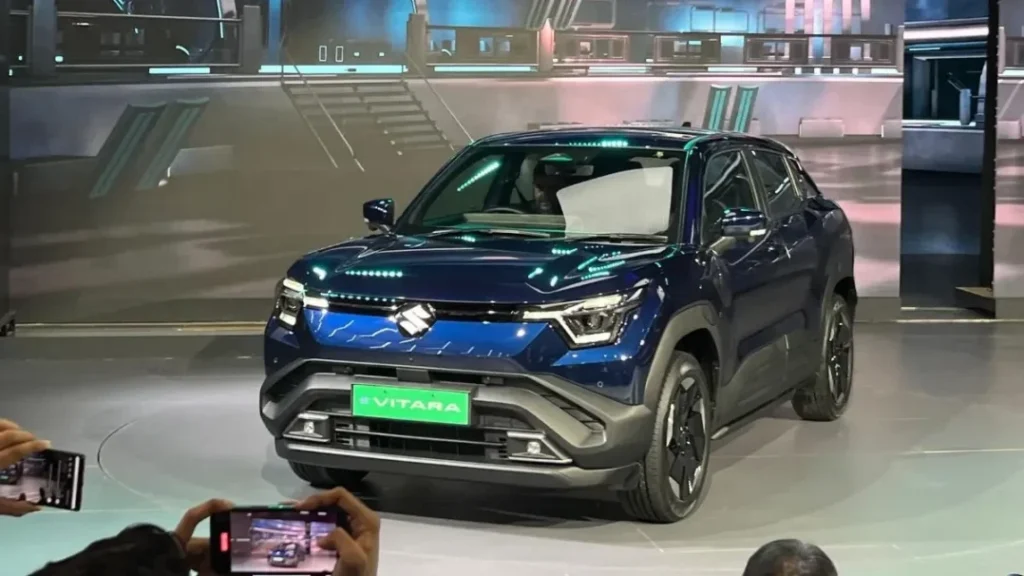
Maruti Suzuki has indicated that supplies of its first all-electric SUV, the e Vitara, are likely to remain constrained in the near term, with production limitations expected to ease only after July. The company is currently juggling electric vehicle output with export commitments and strong domestic demand for other models manufactured on the same assembly line.
The situation means that customers planning to buy the e Vitara may continue to face long waiting periods over the next few months, despite rising interest in Maruti’s maiden EV offering.
Shared Production Line Limits Early Volumes
Speaking at a recent media roundtable, Partho Banerjee, Senior Executive Officer for Marketing and Sales, said that the e Vitara is being produced on a shared manufacturing line at Maruti’s Gujarat facility.
The plant has an annual capacity of around 1,00,000 units, but this capacity is not dedicated exclusively to the electric SUV. Instead, the same line also produces other high-demand models, which continue to see strong bookings in both domestic and overseas markets.
As a result, Maruti has limited flexibility to ramp up e Vitara production quickly, especially during the early phase of its lifecycle.
Export Commitments Add to Pressure
Another major factor affecting availability is Maruti’s export strategy. A significant portion of vehicles produced at the Gujarat plant is earmarked for international markets, where the company has been steadily expanding its footprint.
With export volumes remaining strong, a sizeable share of production capacity is locked in for overseas shipments. This further reduces the number of e Vitara units that can be allocated to Indian customers in the short term.
Company officials have acknowledged that balancing domestic demand, export obligations, and EV production has become increasingly challenging.
Improvement Expected in Second Half of FY2026
According to Maruti Suzuki, the supply situation is expected to improve in the second half of FY2026, once capacity constraints begin to ease. The company is working on optimising production schedules and gradually scaling up EV output.
Industry observers believe that as operational efficiencies improve and demand for other models stabilises, more slots can be allocated to the e Vitara. This should help reduce waiting periods and improve showroom availability later in the year.
However, until these adjustments take effect, supply is likely to remain tight.
Rising Demand for Maruti’s First EV
The e Vitara represents a major milestone for Maruti Suzuki as it enters India’s fast-growing electric SUV segment. Backed by the company’s extensive sales and service network, the model has attracted strong initial interest from urban and semi-urban buyers alike.
With its focus on range, practicality, and affordability, the e Vitara is positioned as a mass-market EV aimed at first-time electric car buyers. This has translated into healthy bookings soon after launch, adding further pressure on limited production capacity.
Strategic Balancing Act Ahead
For Maruti Suzuki, the current supply challenge highlights the complexities of transitioning to electric mobility while continuing to dominate the internal combustion engine market. The company must carefully balance three priorities: sustaining exports, meeting demand for popular ICE models, and scaling up EV production.
In the coming months, how effectively Maruti manages this balancing act will be crucial in shaping the e Vitara’s long-term success.
For now, prospective buyers may need to exercise patience, as meaningful improvement in availability is expected only after July, when production constraints are likely to ease and capacity allocation becomes more flexible.