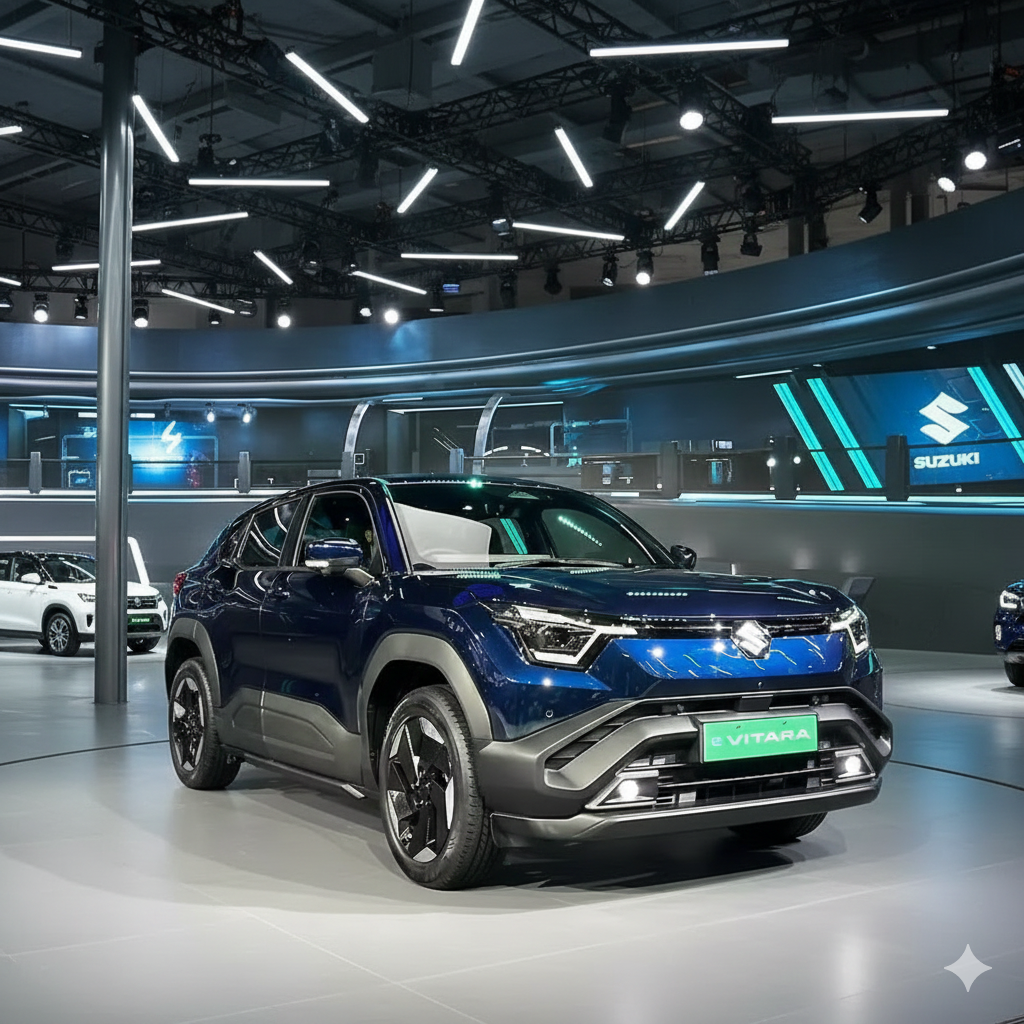
Maruti Suzuki’s much-anticipated entry into the full-electric SUV segment, the e Vitara, is set to have its official pricing revealed imminently, as the model gears up for a February 2026 launch in India.
After its global unveiling and an India showcase in late 2025, the e Vitara—Maruti’s first dedicated battery-electric vehicle—has generated significant buzz. While specifications like battery options, claimed range, and features have been discussed extensively, industry watchers emphasize that the true game-changer will be its positioning on the price chart. The vehicle is widely expected to target the ₹15 lakh to ₹25 lakh ex-showroom band, a sweet spot that drives the bulk of SUV sales volume in the country.
This price range represents the heart of India’s booming mid-size SUV market, where models like the Hyundai Creta, Kia Seltos, Tata Curvv, and Mahindra XUV700 dominate with strong demand. However, it’s precisely here that pure EVs have historically faced their toughest challenges. High upfront costs—largely due to reliance on imported batteries, electric motors, power electronics, and other critical components—have kept most electric SUVs priced noticeably higher, limiting mass appeal despite growing interest in zero-emission mobility.
Maruti Suzuki’s approach with the e Vitara appears calibrated to bridge this gap. The model offers two battery pack choices: a smaller ~49 kWh unit and a larger 61.1 kWh variant, delivering a claimed range of up to around 543 km on the bigger pack. Power outputs are expected in the 142–172 bhp range, with options for front-wheel drive and potentially all-wheel drive in select trims. Safety credentials include a five-star Bharat NCAP rating, while features encompass Level-2 ADAS, panoramic sunroof, 360-degree camera, and modern infotainment.
By aiming for the ₹15–25 lakh territory, Maruti is signaling an aggressive push for volume over premium margins in its EV debut. A starting price closer to the lower end (around ₹17–18 lakh for base variants, as per various estimates) could enable quicker scale-up, build buyer confidence, and accelerate charging infrastructure habits among mainstream customers. Higher-end trims nearing ₹22–25 lakh would still compete head-on with established ICE and hybrid rivals while offering EV benefits like lower running costs and instant torque.
The pricing announcement—anticipated very soon—will clarify Maruti’s strategy: whether it’s prioritizing rapid market penetration with thinner initial margins or protecting profitability amid component cost realities. Either way, the e Vitara’s arrival could reshape the competitive landscape in India’s electric mid-size SUV space, challenging players like the Tata Curvv EV, Mahindra BE 6, Hyundai Creta Electric, and MG Windsor EV.With Maruti’s vast dealer network, service ecosystem, and reputation for reliability, a competitively priced e Vitara has the potential to drive meaningful EV adoption beyond early adopters. As February 2026 approaches, all eyes remain on the final numbers that will determine if this badge can finally make electric SUVs a realistic choice for the average Indian family buyer.