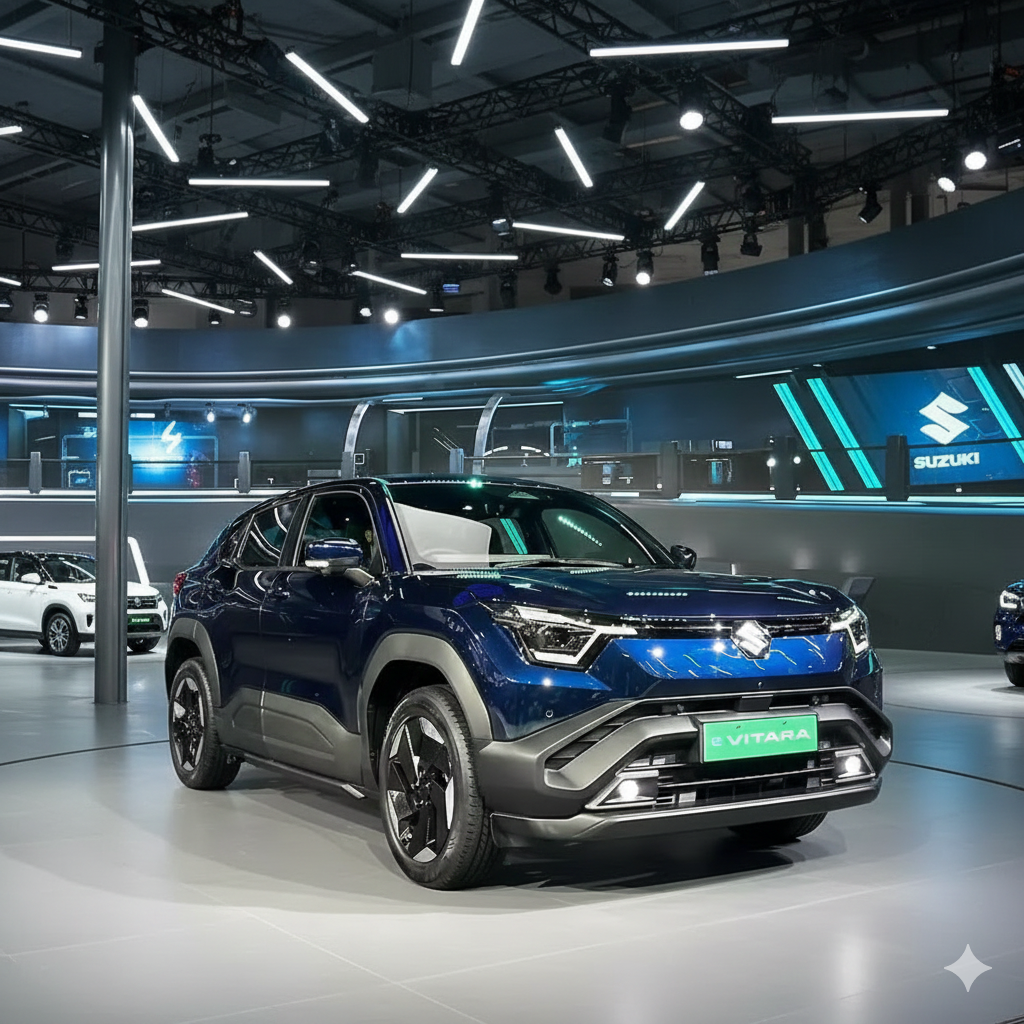
In a landmark move for India’s electric vehicle landscape, Maruti Suzuki, the country’s largest carmaker, is gearing up to launch its first battery-electric SUV, the e Vitara, on December 2, 2025. This unveiling in Gurugram isn’t just about introducing a new model—it’s a bold statement of intent to build a full-fledged EV ecosystem that addresses the biggest hurdles for adoption: range anxiety, charging infrastructure, and seamless ownership. With production already humming at the Gujarat facility and exports underway, the e Vitara promises to blend glob
The e Vitara’s story begins in Gujarat, where Maruti Suzuki’s Hansalpur plant—inaugurated by Prime Minister Narendra Modi on August 26, 2025—has become the epicenter of the company’s EV ambitions. This state-of-the-art facility, with an annual capacity of 750,000 units, isn’t just churning out vehicles for domestic roads; it’s positioning India as Suzuki’s global EV hub. Production kicked off with a focus on exports, and by September 2025, the first batch of over 2,900 units had shipped from Pipavav Port to 12 European markets, including the UK, Germany, France, Norway, and Sweden. Plans extend to over 100 countries, with Japan set to welcome it alongside India’s January 2026 sales start.
What makes this “Made in India, Made for the World” ethos shine? The e Vitara is built on the dedicated HEARTECT-e platform, co-developed with Toyota, emphasizing lightweight construction, a low center of gravity, and robust safety. It’s no surprise it earned a five-star Bharat NCAP rating right out of the gate. For Indian buyers, this means a vehicle that’s not only export-quality but tailored for local conditions, tested over 10 million kilometers in extremes from -30°C to +60°C.
At the heart of the e Vitara are two lithium-iron-phosphate (LFP) battery packs sourced from BYD, known for their durability and safety. Buyers will choose between a 49 kWh unit (exclusive to front-wheel-drive setups) and a larger 61.1 kWh option, both delivering instant torque and whisper-quiet performance. The smaller pack pairs with a single front-axle motor producing 142 bhp and 189 Nm, ideal for urban zips with a WLTP range of around 344 km. Opt for the 61.1 kWh, and you get 172 bhp in 2WD mode, stretching to an ARAI-certified 543 km—enough for a Delhi-Chandigarh round trip without breaking a sweat. Charging is a breeze too: DC fast-charging takes the larger battery from 0-80% in under 50 minutes, while home AC setups handle overnight top-ups. And with drive modes like Eco, Normal, Sport, and even Snow for off-road flair, the e Vitara adapts to India’s diverse terrains. Priced tentatively between ₹17-25 lakh (ex-showroom), it slots into three variants—Delta, Zeta, and Alpha—offering a premium cabin with dual 10-inch screens, ventilated seats, a panoramic sunroof, and Level 2 ADAS features like adaptive cruise control and lane-keep assist.
Maruti Suzuki isn’t stopping at hardware—they’re architecting an ecosystem to make EV ownership effortless. The largest car producer in the country is also working towards helping establish a nationwide network of over one lakh public charging points by 2030. To further reduce concerns around charging availability, Maruti Suzuki has partnered with 13 major charging point operators and aggregators—allowing users to access multiple charging networks through a single platform. This “One India, One EV Charging” initiative already boasts over 2,000 Maruti-branded points across 1,100+ cities, with chargers spaced every 5-10 km in the top 100 urban hubs and fast-chargers along highways.
A game-changer that unifies everything. From booking home charger installations to locating public stations, reserving slots, and paying via UPI or Maruti Suzuki Money, it’s all in one place. Mirror the interface to your e Vitara’s infotainment for on-the-go management, and join the ‘e Drive’ pan-India tour to test real-world charging. Backing this are 1,500 EV-ready workshops, a 1.5 lakh-strong trained workforce, and even skill programs at 130 ITIs. Add Battery-as-a-Service (BaaS) options and assured buybacks, and Maruti is tackling affordability head-on.
The e Vitara isn’t just Maruti’s EV debut—it’s a blueprint for mass adoption. In a market where Tata and Mahindra lead but infrastructure lags, Maruti’s scale (over 1.8 million annual sales) and dealer network give it unmatched reach. While the e Vitara rivals the Tata Curvv EV and Hyundai Creta EV with its blend of range, features, and value, the real edge is the ecosystem. Bookings open soon via NEXA outlets, with deliveries from January 2026.
As Hisashi Takeuchi, MD & CEO of Maruti Suzuki, puts it: “We’re EV-ready and ‘By Your Side’ to build lasting trust.” With the e Vitara, Maruti isn’t just arriving—it’s redefining the road ahead, one charge at a time. If sustainable driving was a distant dream, this SUV and its ecosystem just made it electrifying real.