Maruti Suzuki will enter India’s electric vehicle market with the launch of its first all-electric SUV, the e-Vitara, on December 2, marking a major step toward sustainable mobility. Maruti Suzuki is set to make its long-awaited debut in India’s electric vehicle segment with the launch of its first-ever EV, the e-Vitara, on December 2, 2025. First showcased at the Bharat Mobility Auto Expo 2025, the e-Vitara marks a major turning point for India’s largest carmaker as it steps into the era of electric mobility.
With over 50% market share in India’s passenger vehicle space, Maruti Suzuki has been under pressure to join the EV revolution amid growing government incentives and consumer demand for greener alternatives. The e-Vitara, built on Suzuki’s innovative HEARTECT-e platform, promises to blend the brand’s signature affordability and reliability with cutting-edge electric performance.
This launch not only positions Maruti as a serious contender against established players like Tata Motors and Mahindra but also aligns with India’s ambitious target of 30% EV penetration by 2030.
A Design That Turns Heads: Futuristic Yet Familiar
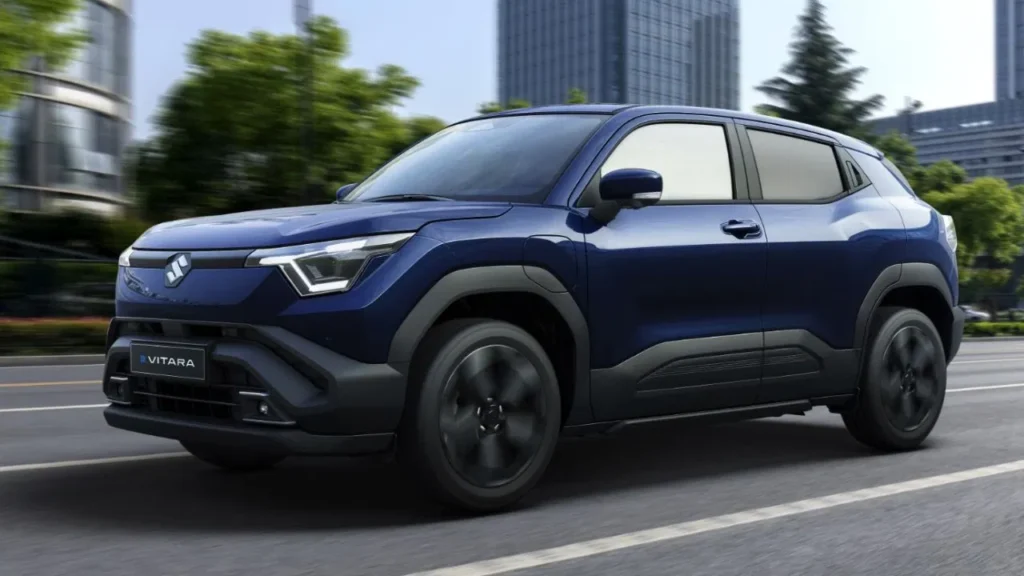
The e-Vitara draws inspiration from its petrol-powered Grand Vitara sibling but evolves into a sleeker, more aerodynamic form tailored for electric efficiency. Its polyhedral muscular stance, sculpted 3D appearance, and futuristic front fascia give it a bold, road-ready presence.
Standout exterior elements include R18 aerodynamic alloy wheels, NEXTrè 3-point matrix LED daytime running lights (DRLs), and matching rear lamps that ensure visibility and style.Inside, the cabin emphasizes space and luxury. A long wheelbase maximizes legroom, while features like ventilated front seats, a 10-way power-adjustable driver’s seat, and sliding/reclining rear seats (with up to 20 degrees of recline) cater to comfort on long drives.
The 40-20-40 split rear seats and flexible boot space add practicality for families or adventurers. Tech-savvy buyers will appreciate the 26.04 cm multi-information display, twin-deck floating console with shift-by-wire, ambient multi-color lighting, a fixed-glass sunroof, and wireless charging.
Powertrain and Performance: Efficiency Meets Exhilaration
At its core, the e-Vitara is powered by a high-capacity lithium-ion battery pack comprising 120 cells, designed to operate reliably in extreme temperatures from -30°C to 60°C—ideal for India’s diverse climates.
It will be available in two battery variants: a 49 kWh unit and a larger 61 kWh option, both delivering an impressive claimed range of up to 500 km on a single charge. Performance-wise, expect front-wheel-drive (FWD) models with 142 bhp and 192.5 Nm of torque from the base battery, scaling up to 172 bhp in higher trims, potentially with all-wheel-drive (AWD) options.
Acceleration is brisk, with 0-100 km/h times around 4.6 seconds in top variants, thanks to instant electric torque. Advanced aerodynamics further enhance range and efficiency, making it suitable for urban commutes or highway jaunts. Safety is paramount, with Level 2 Advanced Driver Assistance Systems (ADAS) including adaptive cruise control, lane-keeping assist, and automatic emergency braking, supported by seven airbags and a robust suite of sensors.
Pricing and Variants: Accessible Electrification
Maruti Suzuki’s EV entry is poised to disrupt the mid-size SUV segment with competitive pricing. The e-Vitara is expected to start at around ₹17 lakh for the base 49 kWh FWD variant, climbing to ₹22.5 lakh for the top-spec 61 kWh AWD model (ex-showroom).
This positions it as a value-for-money rival to the Mahindra BE 6, Hyundai Creta Electric, and Tata Curvv EV
Buyers can look forward to Suzuki Connect telematics, offering smartwatch integration for charging alerts, navigation to nearby stations, and remote scheduling via the e-for-me app. Maruti’s expanding fast-charger network and home installation services will ease range anxiety, backed by “Service on Wheels” for remote support.
Market Impact: Paving the Way for Maruti’s EV Future
This launch is just the beginning for Maruti Suzuki, which has confirmed plans for eight new SUVs, including hybrids and CNG models, by 2030. The e-Vitara’s made-in-India production at Suzuki’s Gujarat facility underscores the company’s commitment to local manufacturing and export potential.
As India races toward net-zero emissions, Maruti’s entry could accelerate EV adoption among the masses. With its blend of practicality, tech, and eco-friendliness, the e-Vitara isn’t just a vehicle—it’s a bridge to a electrified tomorrow. Bookings are expected to open soon after the unveiling; enthusiasts should keep an eye on NEXA showrooms for test drives.