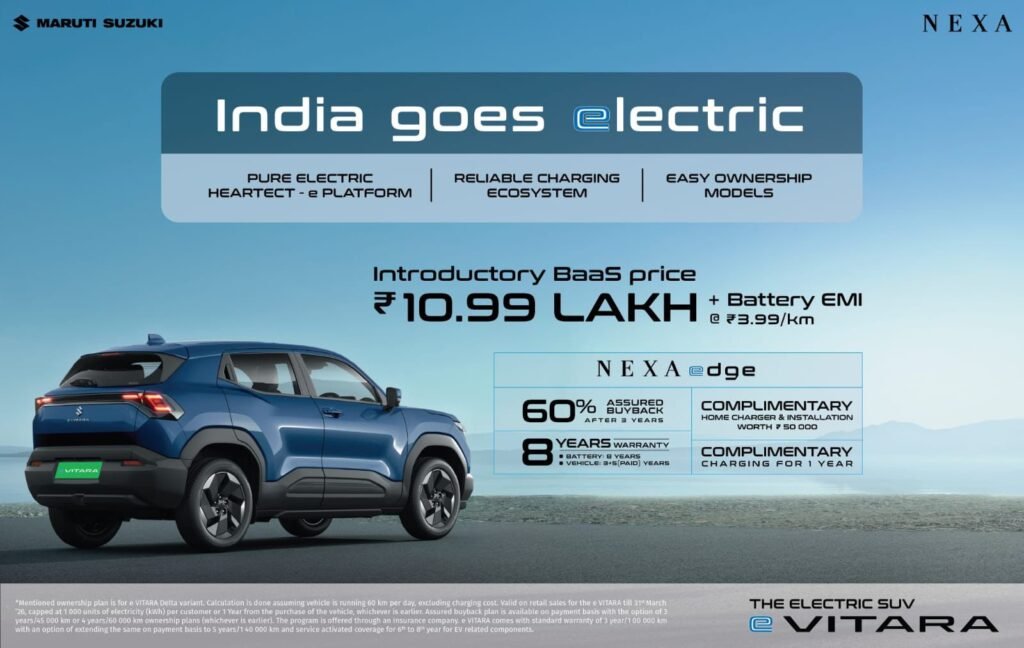
Maruti Suzuki India Limited has officially entered the electric passenger vehicle space with the launch of its first EV, the e Vitara, announcing an introductory price of ₹10.99 lakh (ex-showroom). However, this figure applies to the base variant without the battery, as the model is being offered under a Battery-as-a-Service (BaaS) ownership structure.
Under this model, customers pay separately for battery usage, with an EMI-linked cost of around ₹3.99 per kilometre. While this approach allows Maruti to project a relatively low starting price, it also shifts a significant portion of ownership cost into long-term usage, making the real price of the vehicle less straightforward.
/
The ₹10.99 lakh tag is widely seen as a headline-grabbing introductory figure rather than a true reflection of what most buyers will eventually pay. It applies only to the entry-level variant and excludes the most expensive component of an EV. A similar strategy was previously seen in the market when MG introduced a BaaS model with an attractive sub-₹10 lakh starting price.
Considering current electric vehicle pricing trends and taxation, industry observers expect the base variant of the e Vitara with battery included to cost close to ₹16 lakh on-road in many cities. Higher variants, especially those with larger batteries and more features, are likely to cross ₹20 lakh on-road, placing the car firmly in the premium compact SUV segment.
Alongside the launch, Maruti has introduced an extensive ownership package aimed at reassuring buyers who may be hesitant about switching to electric mobility. This includes a 60 percent assured buy-back after three years, an eight-year warranty on the battery, a three-year vehicle warranty with an optional five-year extension, and complimentary home charger installation. Buyers also receive free public charging for one year and access to more than 2,000 charging points across Maruti’s dealer network, with plans to expand to over one lakh public charging points by 2030 through partnerships.
The e Vitara is offered with two battery options, a 49 kWh pack and a larger 61 kWh unit, with a claimed driving range of up to 543 kilometres. It also features Level-2 ADAS, connected car technology, and a modern infotainment system, positioning it as a technologically competitive product in its segment.
One of the strongest advantages in Maruti’s favour is its long-standing reputation for reliability and its unmatched service network across India. For many first-time EV buyers, especially in smaller cities and towns, this trust factor could play a decisive role. The promise of easy service access, affordable maintenance, and long-term peace of mind may outweigh concerns about higher upfront or running costs.
At the same time, the pricing strategy raises an important question for potential customers. While the introductory price looks attractive on paper, the final cost of ownership depends heavily on battery usage, financing terms, and driving patterns. Buyers who clock high daily mileage may find the per-kilometre battery charge adds up quickly over time.
The success of the e Vitara may therefore hinge on whether customers focus more on the low entry price or carefully evaluate the total cost over several years. As competition intensifies in the electric SUV space, transparency in pricing and ownership economics will become increasingly important.