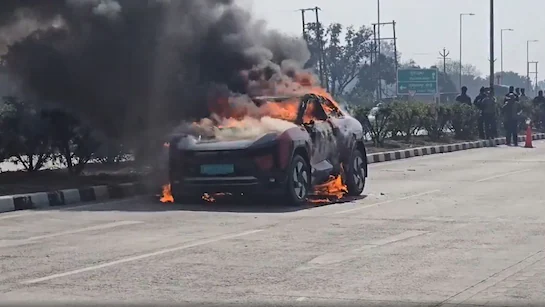
The viral video of a Mahindra BE 6 electric SUV engulfed in flames near Gulaothi (in Uttar Pradesh’s Hapur district) sparked immediate concern and speculation. Social media was quick to point fingers at electric vehicle (EV) battery safety, with critics and “EV haters” amplifying fears about thermal runaway risks in India’s growing EV market.
But Mahindra has now issued a detailed official statement that flips the narrative entirely. The company’s thorough on-site investigation—backed by onboard sensor data, software diagnostics, and analysis of bystander footage—confirms the high-voltage battery and electric motor remained fully intact, unaffected, and functional throughout the incident. Battery health parameters, including individual cell voltages, stayed within safe limits despite external thermal stress.
The root cause? A fully deflated rear right tyre that the driver continued to run on for over 10 minutes at approximately 60 km/h, ignoring repeated tyre pressure monitoring system (TPMS) alerts. This led to excessive friction between the tyre rubber and the road surface, generating intense heat. Onboard systems detected the issue: the Electronic Stability Program (ESP) and Traction Control System (TCS) actively intervened to manage wheel spin, a high-temperature alert for the rear wheel triggered protective measures (including speed limiting and eventual system shutdown), safely halting the vehicle. The fire originated from the overheated tyre rubber—not the EV powertrain.
All safety systems performed as designed, allowing the driver and occupants to exit unharmed. Mahindra emphasized that customer safety is their highest priority and urged drivers to always heed vehicle warnings, as TPMS alerts are there precisely to prevent such scenarios.
This incident highlights a critical point: tyre maintenance remains a universal responsibility, regardless of whether a vehicle is ICE or electric. Modern cars like the BE 6 come equipped with advanced TPMS to flag low pressure or overheating, yet ignoring these can lead to dangerous outcomes—even catastrophic friction fires, as seen here. EVs don’t inherently increase fire risk from tyres; driver behavior does.
In the broader context of India’s EV push—where models like the BE 6 represent homegrown innovation in sustainable mobility—this clarification is a reminder that not every fire is a “battery fire.” Data consistently shows EV fires are rarer than those in internal combustion engine vehicles, and when they do occur, they’re often unrelated to the battery (as in this case).EV skeptics who rushed to judgment have gone quiet as the facts emerge. Mahindra’s transparent response reinforces trust in the brand’s engineering and safety standards. For EV owners and potential buyers, the takeaway is simple: respect your vehicle’s alerts, check tyres regularly, and drive responsibly—the technology is built to keep you safe when you do.