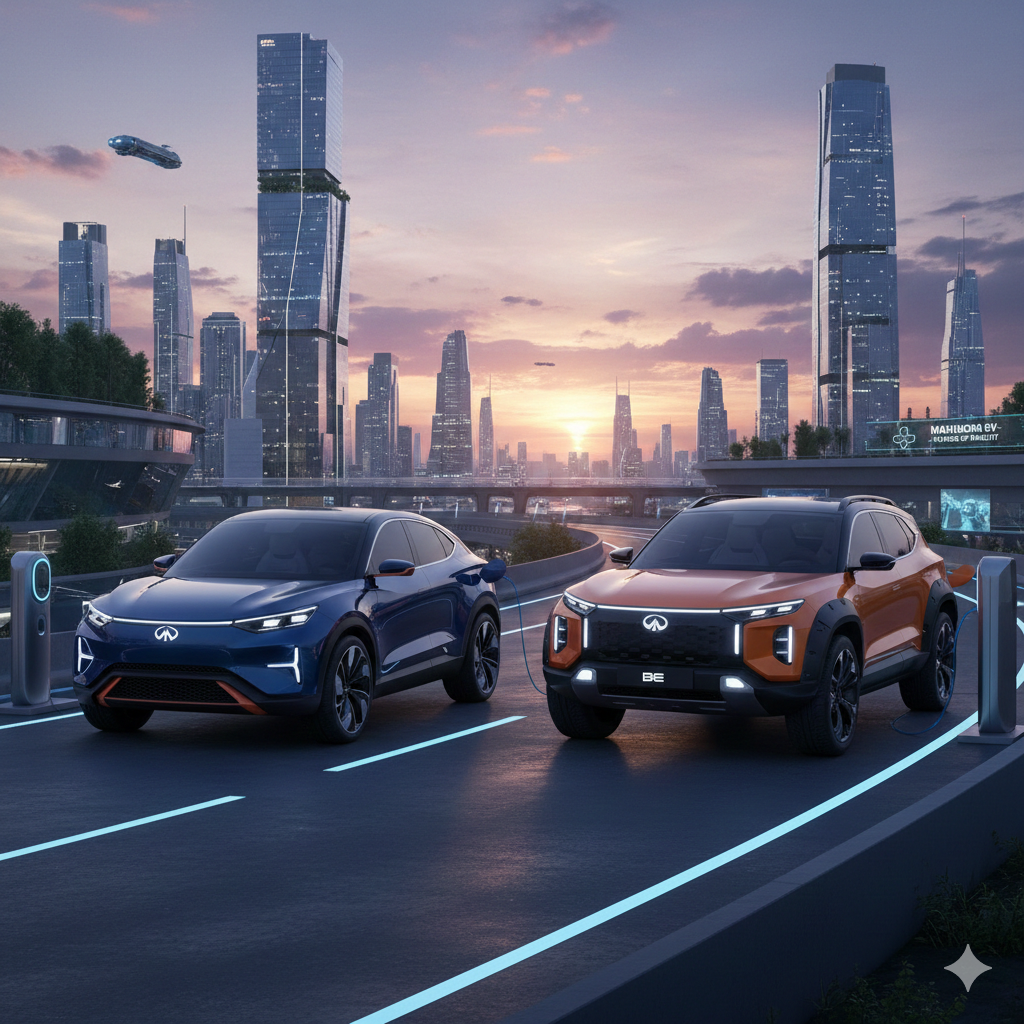
Mahindra & Mahindra is gearing up to significantly ramp up production of its Born Electric range, riding on strong market interest in its new-generation electric vehicles. Currently, the company is manufacturing close to 5,000 units per month of the recently launched XEV 9e and BE 6 combined. However, the automaker has already initiated plans to add another 3,000 units of monthly capacity before the end of the current financial year (March 2025).This planned expansion will push Mahindra’s monthly EV output to approximately 8,000 units in the near term, marking a sharp increase in production volume within months of the two models hitting the market.
The company’s existing manufacturing infrastructure at its Chakan facility in Maharashtra is already capable of producing up to one lakh (100,000) electric vehicles annually. Mahindra has further confirmed that the same plants can be scaled up to two lakh units per year if sustained demand justifies the investment. With a robust order bank and positive early response, the groundwork for such scaling is already in place.
Mahindra is also preparing for the next wave of Born Electric models based on its dedicated INGLO skateboard platform, which will debut additional SUV body styles in the coming years and further broaden the portfolio.
One of the biggest highlights of the new Mahindra EVs is their operating economics. The flagship XEV 9e is claimed to deliver a running cost of just ₹1.2 per kilometre, while maintenance costs are pegged at an impressively low 40 paise per kilometre — roughly one-third that of comparable internal-combustion vehicles.
For commercial and fleet operators, the financial appeal is even stronger. Mahindra says buyers can avail accelerated depreciation benefits of up to 40% in the first year itself under current tax regulations, significantly improving total cost of ownership and payback periods for high-utilisation users.
The XEV 9e is offered with three battery pack options — 59 kWh and 79 kWh variants that use LFP (lithium iron phosphate) chemistry for enhanced safety and longevity, along with an additional configuration to suit varying customer requirements. Real-world range is claimed to exceed 600 km in the top-spec 79 kWh version under Indian testing conditions.
With production scaling, compelling economics, and an expandable INGLO-based pipeline, Mahindra is positioning itself aggressively in India’s fast-growing electric passenger vehicle segment, where it now ranks among the top domestic players behind Tata Motors. The coming quarters will reveal whether the expanded capacity is sufficient to meet what appears to be rapidly growing consumer and fleet demand for its Born Electric lineup.
One of the biggest highlights of the Mahindra XEV 9e is its remarkably low cost of operation. The company claims a running cost of just ₹1.2 per kilometre (including electricity and basic maintenance), while pure maintenance expenses can be as low as 40 paise per kilometre — a fraction of what internal-combustion rivals demand.For commercial buyers and fleet operators, the financial appeal is further sweetened by accelerated depreciation benefits of up to 40% in the first few years, making the XEV 9e an attractive proposition for taxi aggregators, delivery companies, and corporate fleets looking to electrify profitably.The XEV 9e is offered with three battery pack options, allowing customers to choose the range and price point that best suits their needs:
- 59 kWh pack (targeting ~500 km claimed range)
- 69 kWh pack
- Top-spec 79 kWh pack (delivering up to 656 km on a single charge in ideal conditions)
Fast-charging capability (up to 175 kW) enables 0–80% charge in under 20 minutes, addressing one of the biggest pain points for EV adoption in India.
While the XEV 9e and BE 6 mark Mahindra’s bold entry into the premium electric space, the INGLO skateboard platform has been engineered with scalability in mind. The architecture will underpin a broader family of Born Electric SUVs in the coming years, including more accessible models positioned below the current duo as well as larger, luxury-oriented offerings.
With production capacity being readied for a potential doubling and a versatile EV platform in place, Mahindra is clearly positioning itself to capture a sizeable slice of India’s fast-growing electric passenger vehicle market in the second half of the decade.As charging infrastructure expands and battery costs continue to fall, the combination of futuristic design, segment-leading running costs, and aggressive capacity expansion could well propel Mahindra into the top league of EV manufacturers in India. For now, the company is leaving no stone unturned to convert the excitement around its Born Electric range into tangible volumes on the road.