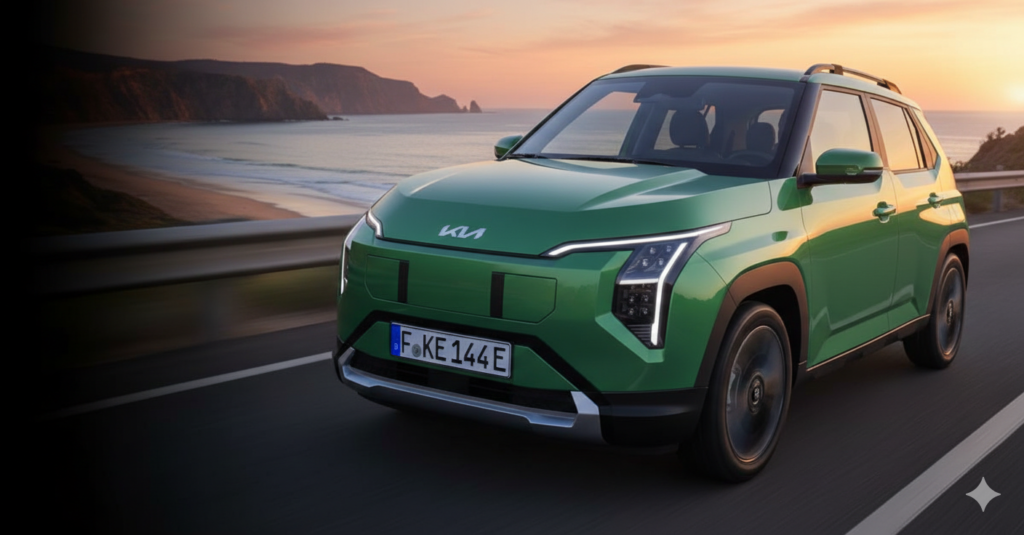
The Indian electric SUV market is on the cusp of becoming even more intensely competitive, and Kia India is poised to intensify the battle with its upcoming mass-market contender: the Kia Syros EV. Recent spy shots of the vehicle undergoing rigorous road testing across Indian conditions—from Delhi-NCR to other hotspots—signal that the Korean automaker is accelerating toward a launch, marking Kia’s first truly accessible electric SUV for the broader Indian buyer.
Until now, Kia’s EV portfolio in India has remained premium-focused, limited to the sporty EV6 (priced well above ₹60 lakh) and the flagship seven-seater EV9 (even higher). These models cater to luxury and performance enthusiasts but remain out of reach for the average family buyer. The Syros EV changes that equation dramatically, targeting the heart of the booming compact-to-midsize electric SUV segment where the Tata Nexon EV (India’s bestseller) and Mahindra XUV400 (now evolving into XUV 3XO EV) have built dominant recall and loyalty.
The latest undisguised or lightly wrapped test mules spotted in early-to-mid February 2026 show the Syros EV in heavy camouflage during real-world validation in Delhi-NCR and other regions. Key observations from these sightings include:
- A front-fender-mounted charging port (a clear EV giveaway).
- Aero-optimized alloy wheels for improved efficiency.
- Retained boxy, upright silhouette with quirky headlights and tall greenhouse from the ICE Syros (launched in February 2025).
- EV-specific tweaks like modified bumpers, potential closed grille elements, and lime-green brake calipers hinting at sportier GT-line variants.
- Similar overall proportions to the petrol/diesel Syros (~3,995 mm length), ensuring sub-4 metre tax benefits and urban agility.
These prototypes are enduring India’s diverse conditions—potholes, heat, traffic, and highways—indicating Kia is fine-tuning for local durability, ride comfort (expected firmer setup), and thermal management.
The Syros EV is anticipated to borrow battery and motor tech from Hyundai’s ecosystem (shared platforms with models like the Creta EV or Inster):
- Battery options: Likely 42 kWh and 51.4 kWh packs (or similar 42-49 kWh configurations).
- Claimed ARAI range: 390-510+ km depending on the pack, with real-world expectations of 300-450 km in mixed Indian driving.
- Charging: Fast DC support for 10-80% in around 58 minutes; home AC charging for overnight convenience.
- Drivetrain: Front-wheel drive (no AWD expected), single-motor setup delivering peppy performance suitable for city and highway use.
Features are expected to mirror the loaded ICE Syros—Level-2 ADAS, panoramic sunroof, ventilated seats, dual 12.3-inch screens, 360-degree camera, Bose audio, and more—plus EV exclusives like V2L (vehicle-to-load) for powering appliances and potentially enhanced regenerative braking.
Priced aggressively in the ₹14-20 lakh ex-showroom range (estimates vary; entry variants around ₹14-16 lakh), the Syros EV will directly challenge:
- Tata Nexon EV (strong sales leader with proven reliability).
- Mahindra XUV 3XO EV / XUV400 EV.
- Other rising players like MG Windsor EV, Tata Curvv.ev, and Hyundai’s upcoming compact offerings.
Kia’s advantages include its premium build quality, extensive feature list, growing dealer/service network, and brand appeal in aspirational segments. A 2026 launch—potentially mid-to-late year (some reports point to Q3-Q4, others earlier)—aligns with Kia’s push to expand its EV lineup beyond premiums, capitalizing on rising charging infrastructure and government incentives.
The Indian electric SUV space is exploding, driven by demand for practical, feature-rich, and range-anxiety-free options in the ₹10-25 lakh bracket. With the Nexon EV commanding massive volumes, Kia’s entry with the Syros EV could fragment the market further, forcing competitors to innovate on pricing, features, and after-sales.Spy shots confirm Kia is serious and close—testing rigor suggests production validation is underway. As festive seasons and new EV policies approach, expect more teasers soon. The Syros EV isn’t just another launch; it’s Kia’s bid to claim a slice of the mass-market EV pie and make electric SUVs truly mainstream in India. Watch this space—the ring is getting crowded, and Kia is stepping in swinging.