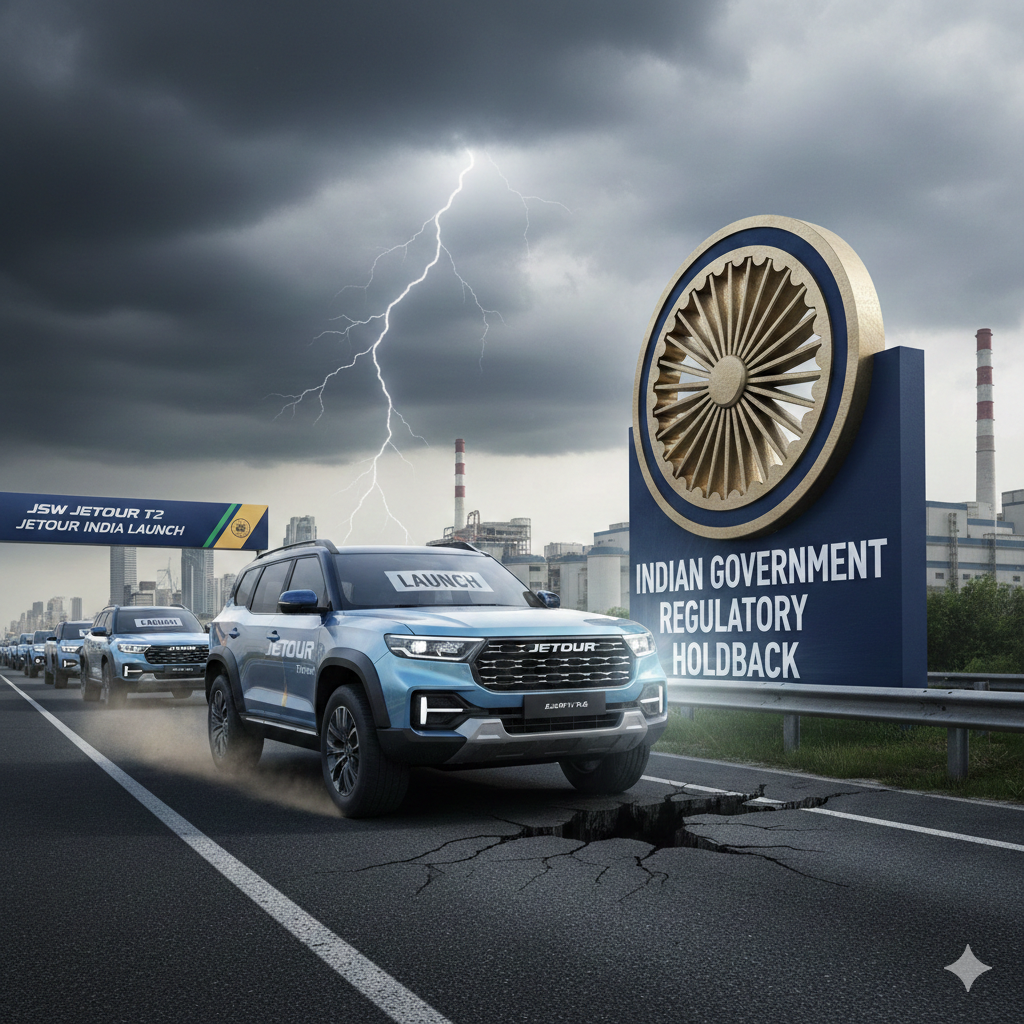
The much-awaited entry of JSW Group into India’s passenger vehicle market has hit a major regulatory hurdle. The company’s plan to launch the Jetour T2, a rugged plug-in hybrid SUV, is reportedly facing serious delays due to strict government policies on Chinese-linked investments and imports.
Originally expected to debut around the festive season of 2026, the Jetour T2 was seen as JSW’s flagship model that would mark its transition into a full-fledged automaker. However, regulatory challenges have now cast uncertainty over its launch timeline.
In recent years, the Government of India has tightened scrutiny over foreign collaborations, especially those involving Chinese companies. These rules were strengthened after 2020 and now require multi-layered approvals for investments, technology transfers, and supply chain partnerships.
Since Jetour is a Chinese SUV brand under the Chery umbrella, JSW’s collaboration has reportedly come under enhanced review. As a result, key clearances related to sourcing, localisation, and technical cooperation are still pending.
The Jetour T2 was expected to play a crucial role in establishing JSW as a serious new player in India’s mobility space. The SUV stands out for its:
- Plug-in hybrid powertrain for better fuel efficiency
- Rugged, boxy, off-road-inspired design
- Advanced infotainment and connectivity features
- Strong appeal to lifestyle and adventure-oriented buyers
With rising interest in hybrid and electric vehicles in India, the Jetour T2 was seen as a well-timed product that could attract both urban and highway users.
Delays in the launch could have long-term implications for JSW Motors. As a new entrant, the company needs a strong and timely debut to build brand trust and market presence.
Industry experts believe the current situation may lead to:
- Postponement of JSW’s passenger vehicle debut
- Increase in project and compliance costs
- Greater focus on localisation of parts and technology
- Possible restructuring of partnerships
JSW may now be forced to look for alternative suppliers or increase domestic manufacturing to meet regulatory expectations.
India’s SUV and green-mobility segments are becoming increasingly competitive. Established players and startups alike are expanding their hybrid and EV portfolios at a rapid pace.
Any delay in launching the Jetour T2 could put JSW at a disadvantage, allowing rivals to strengthen their positions in the mid-size and lifestyle SUV categories.
Despite the setback, JSW Group continues to show strong interest in the mobility sector. The conglomerate is investing in battery manufacturing, EV components, and infrastructure, indicating that automobiles remain a long-term priority.
If regulatory approvals are eventually secured or if the partnership model is modified, the Jetour T2 could still enter Indian showrooms—though later than planned. Until then, JSW’s debut as a standalone carmaker remains on hold, highlighting how policy and geopolitics continue to shape India’s auto industry.