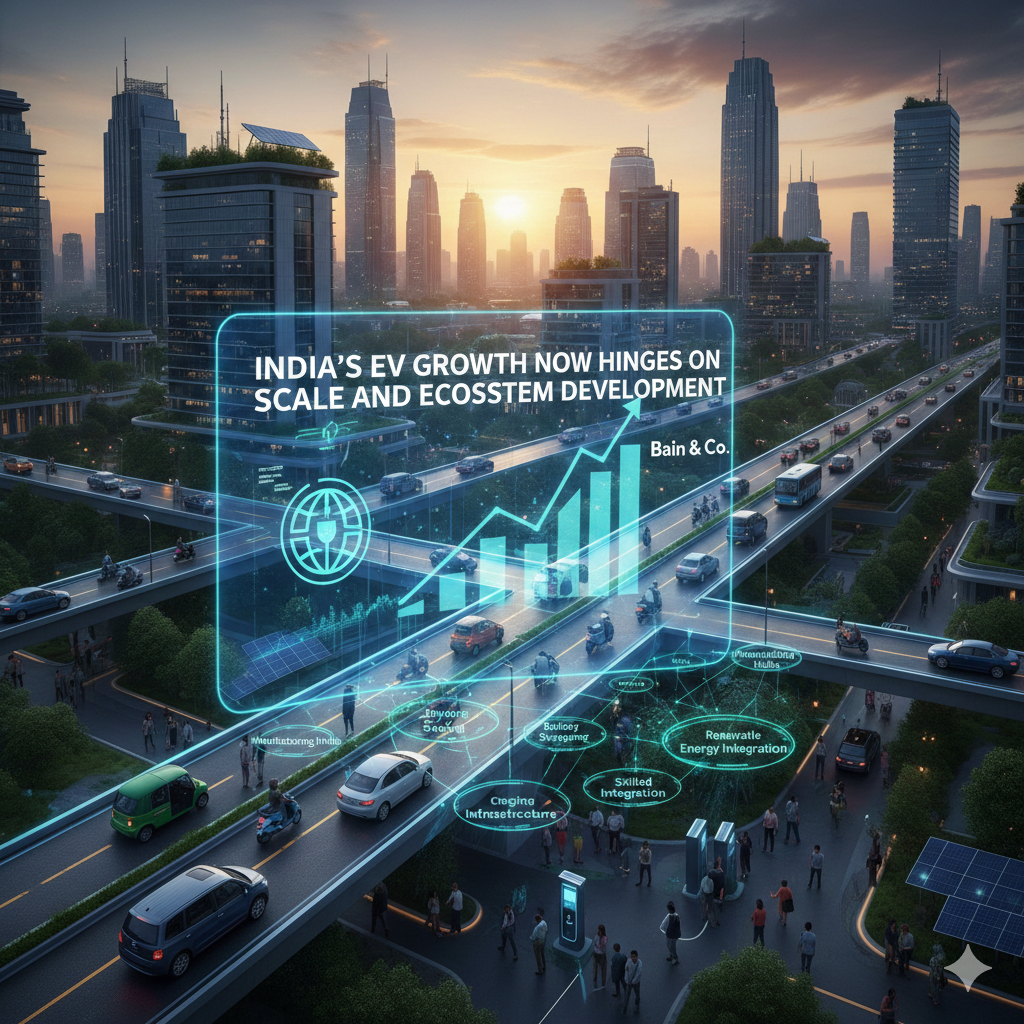
India’s electric mobility journey has entered a decisive new phase, where future growth will be driven by scale, standardisation, resilient supply chains, and skilled manpower, according to Rahul Mishra, Partner at global consulting firm Bain & Company.
Speaking at the Society of Indian Automobile Manufacturers’ (SIAM) Global Electrification Summit, Mishra said the country has moved beyond pilot projects and proof-of-concept stages and is now transitioning into a period of rapid expansion.
“The question is no longer whether electric vehicles will work in India,” Mishra noted. “The focus is now on building a strong, competitive, and sustainable ecosystem around them.”
From Experimentation to Expansion
Over the past decade, India’s EV sector has evolved steadily, supported by government incentives, rising fuel costs, and growing environmental awareness. Early trials and limited deployments have given way to large-scale manufacturing, nationwide sales networks, and expanding charging infrastructure.
Mishra said the industry’s next phase will depend on how effectively stakeholders can scale operations while maintaining quality and affordability. This includes developing common technical standards, strengthening local supply chains for batteries and components, and investing in workforce training.
EV Adoption Reaches New Milestones
India’s electric vehicle adoption crossed a significant threshold in 2025. EVs accounted for nearly 8 per cent of total vehicle sales, with volumes surpassing 2.27 million units, highlighting the sector’s growing mainstream acceptance.
However, adoption levels varied sharply across vehicle categories.
- Passenger electric vehicles recorded a penetration rate of about 4 per cent.
- Electric three-wheelers led the transition, with more than 60 per cent market penetration, driven largely by last-mile mobility and shared transport use.
- Electric two-wheelers continued to gain momentum, reaching 6.3 per cent penetration, supported by improved product offerings and falling battery costs.
These figures underline the uneven pace of electrification, influenced by factors such as vehicle pricing, charging availability, and usage patterns.
Building a Competitive EV Ecosystem
According to Mishra, India’s ability to compete globally in electric mobility will depend on how quickly it can establish robust domestic manufacturing and innovation capabilities. Reducing dependence on imports, particularly for battery cells and critical minerals, remains a key priority.
He emphasised the importance of collaboration between policymakers, automakers, suppliers, and technology providers to create a cohesive ecosystem. Clear regulations, stable incentive frameworks, and long-term policy visibility will be essential to encourage sustained private investment.
Challenges and Opportunities Ahead
Despite strong momentum, the EV sector continues to face challenges, including infrastructure gaps in smaller cities, financing constraints for consumers, and uncertainty around subsidies. At the same time, opportunities are expanding in areas such as battery recycling, energy storage, and software-driven mobility solutions.
With India emerging as one of the world’s fastest-growing EV markets, Mishra said the coming years would be critical in determining whether the country can translate early success into lasting leadership.
“As the industry scales up, execution will matter more than experimentation,” he said, highlighting the shift from innovation-led adoption to efficiency-led growth.