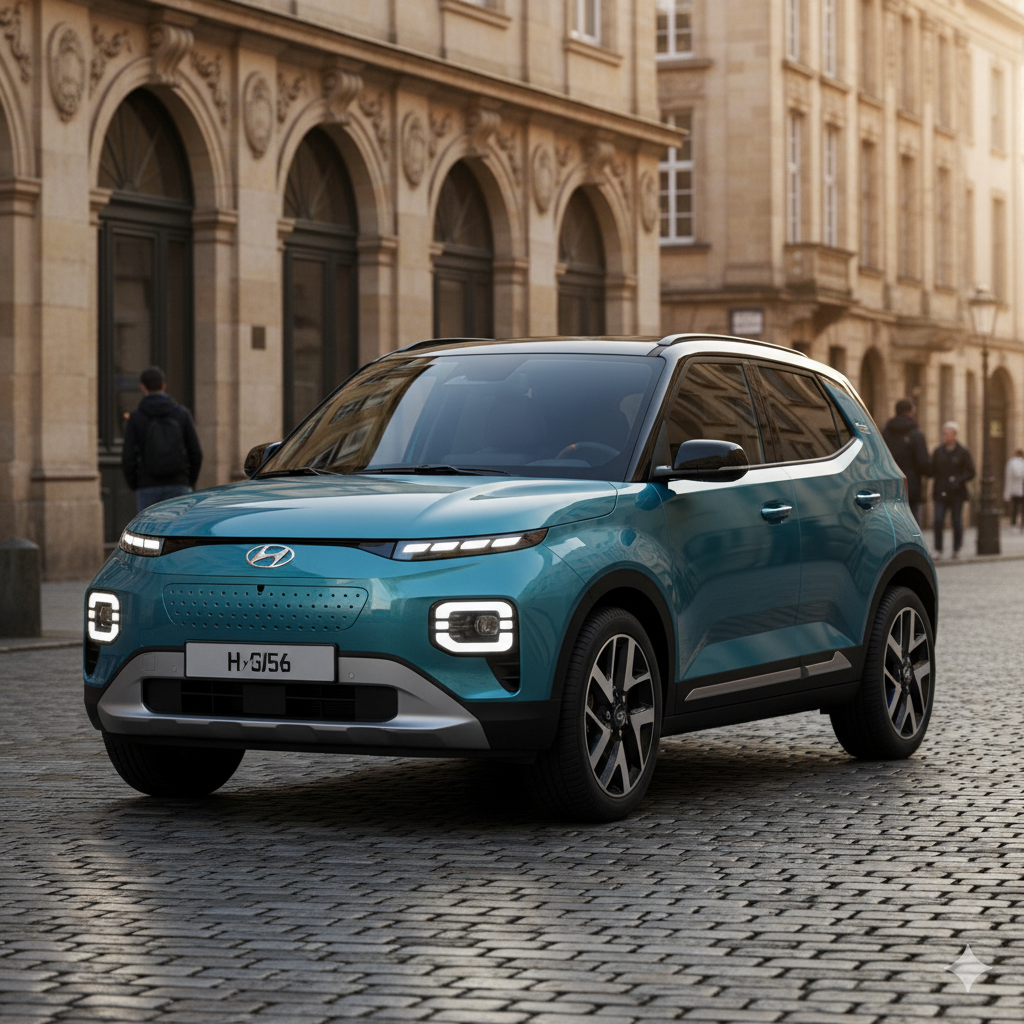
Made in India Hyundai compact EV launch in 2027. Likely to be based on the Hyundai Inster EV, the all-electric compact SUV will be designed, engineered and built in India for Indian customers. At Hyundai’s Investor Day 2025, the Korean company confirmed that a new compact EV will go on sale in India in 2027. Likely to be based on the Inster, the all-electric compact SUV will be “designed, engineered and built in India for Indian customers”, confirmed Jose Munoz, president and CEO of Hyundai Motor Company.
A Bold Entry into India’s Compact EV Segment
Hyundai’s announcement at the 2025 CEO Investor Day marks a pivotal moment for the brand’s electrification strategy in India, where it plans to roll out 26 new or refreshed models by 2030, including hybrids, EVs, and even a premium Genesis lineup. The compact EV, codenamed HE1i, is positioned as Hyundai’s first locally manufactured dedicated electric SUV, aimed squarely at the burgeoning sub-4-metre segment dominated by the likes of the Tata Punch EV. This move underscores Hyundai’s $5 billion investment commitment to India, focusing on factory upgrades, localized R&D, and battery production to bolster its market share in a market projected to see EV adoption surge to 30% by the end of the decade.As we had reported, Hyundai India was given a go-ahead by its Korean parent to challenge the Tata Punch EV earlier this year. With the Punch EV leading sales in the affordable EV space, Hyundai’s entry promises fiercer competition, blending global tech with India-specific tweaks for pothole-ridden roads, sweltering heat, and budget-conscious buyers.
Built on the Affordable E-GMP (K) Platform
New Hyundai compact EV to be based on E-GMP (K) platform. This new sub-4-metre electric SUV will be underpinned by the company’s global and affordable E-GMP (K) platform, also used by the Hyundai Inster on sale abroad. Drawing inspiration from the Inster—a boxy, retro-futuristic A-segment EV unveiled globally—the HE1i will adapt its core architecture for Indian conditions.The Inster EV gets Standard Range and Long Range versions, offering flexibility for urban commuters and longer hauls alike. The Standard Range variant packs a 42 kWh battery, delivering a WLTP-estimated range of up to 355 km (real-world around 255-300 km), while the Long Range ups it to 49 kWh for 360-410 km of travel. Power comes from a front-mounted single motor producing 71-85 kW (95-115 hp) and 147 Nm of torque, with a peppy 0-100 kmph sprint in 10.6 seconds and a top speed of 150 kmph. For the Indian model, expect similar outputs but with localized enhancements like reinforced suspension for rough terrains and a 10-meter turning radius for tight city maneuvers.
Charging will be practical too: 10.5 kW AC for overnight top-ups (full charge in 4-5 hours) and up to 120 kW DC fast charging, adding 100 km in 15 minutes. Priced competitively—likely starting under Rs 10 lakh ex-showroom—the HE1i aims to undercut imports while qualifying for sub-4m tax benefits.
Manufacturing and Localisation: A True ‘Make in India’ Story
This new model will be produced at the company’s Sriperumbudur factory in Tamil Nadu with localised batteries from Exide. Hyundai’s Chennai plant, already a hub for models like the Creta and Venue, will ramp up EV production with dedicated lines, targeting 1 lakh units annually at peak. Partnering with Exide for LFP (lithium iron phosphate) batteries ensures cost efficiency, thermal stability in India’s climate, and supply chain resilience—reducing import duties and slashing prices by 10-15%.Beyond batteries, the HE1i will boast high localisation (over 90%), incorporating India-sourced components for everything from chassis to infotainment, aligning with the government’s PLI scheme for auto components.
Features and Tech: Packed with ADAS and Comfort
Expected to be well-equipped to take on the Tata Punch EV, the HE1i won’t skimp on features. It will debut Level 2 ADAS in this segment, including adaptive cruise control, lane-keep assist, automatic emergency braking, and blind-spot monitoring—powered by a suite of cameras and radars. Inside, expect a 10.25-inch touchscreen with wireless Android Auto/Apple CarPlay, a digital driver’s display, wireless charging, and connected car tech via Hyundai’s Bluelink app.The cabin will seat five comfortably in a 3,800 mm-long body with a 2,580 mm wheelbase, offering 300+ litres of boot space and sliding rear seats for versatility. Dual-zone AC, ventilated front seats, and a panoramic sunroof will cater to family needs, while six airbags, ESP, and 360-degree cameras ensure top safety ratings.
Head-to-Head with Tata Punch EV: How They Stack Up
| Feature | Hyundai HE1i (Expected) | Tata Punch EV |
|---|---|---|
| Price (Ex-Showroom) | Rs 9.5-12 lakh | Rs 9.99-14.44 lakh |
| Battery & Range | 42/49 kWh; 300-400 km | 35 kWh; 315-421 km |
| Power/Torque | 95-115 hp / 147 Nm | 82 hp / 114 Nm (or 122 hp) |
| 0-100 kmph | ~10.6 sec | 9.5 sec |
| Charging | 120 kW DC (100 km in 15 min) | 50 kW DC (full in 56 min) |
| Key Features | L2 ADAS, 10.25″ screen, sunroof | 7″ screen, sunroof (top trims) |
| Warranty | 8 years/1.6 lakh km (battery) | 8 years/1.6 lakh km (battery) |
The Punch EV edges in torque for punchier low-end pull and a slightly longer claimed range, but Hyundai’s superior charging speeds, ADAS suite, and premium fit-finish could sway urban buyers seeking tech smarts over raw utility.
Verdict: Hyundai’s EV Gambit in a Tata-Dominated Turf
Hyundai’s compact EV isn’t just another import—it’s a tailored weapon in the EV wars, leveraging the Inster’s charm with Indian engineering prowess. By 2027, as battery costs dip and charging infra expands, the HE1i could capture 20% of the sub-Rs 15 lakh EV pie, forcing rivals to innovate. For now, it’s a teaser of Hyundai’s 2030 roadmap: more EVs, hybrids, and off-roaders to reclaim the top spot. Keep an eye on prototypes rolling out next year—this little beast might just electrify India’s streets.