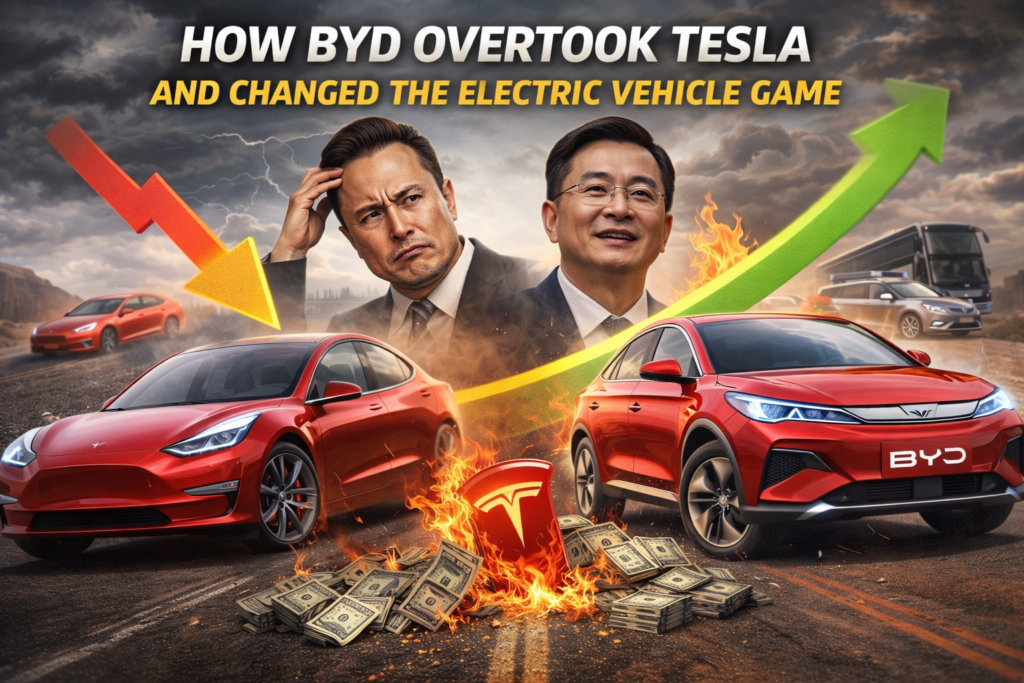
There was a time when China’s BYD was openly mocked on the global stage. Even Tesla founder Elon Musk once laughed off the idea of BYD being a serious competitor, and across the world the company was often trolled as a “cheap Chinese copycat.” But history has taken a dramatic turn. Today, BYD has not only rewritten its own destiny but has also reshaped the global electric vehicle (EV) industry by overtaking Tesla to become the world’s number one EV manufacturer.
In fact, Tesla itself now sources batteries from BYD for some of its models. Beyond that, BYD’s battery technology is quietly powering vehicles from major automakers such as Mahindra, Maruti Suzuki, and Toyota. Legendary investor Warren Buffett backed BYD early on, a move that reportedly delivered returns of over 3,000%. Perhaps most astonishing of all, this massive empire was built not by a scientist or automobile expert, but by a former Chinese government employee with no direct background in cars.
Humble Beginnings of a Visionary Founder
BYD was founded by Wang Chuanfu in 1995. In the early 1990s, Wang worked as a government researcher in China, focusing on materials and battery technology. At the time, the global battery industry was undergoing a major shift. Giants like Sony, Sanyo, and Panasonic were moving away from nickel-cadmium batteries toward lithium-ion technology, which was smaller and more efficient.
Wang saw an opportunity where others did not. While the world was moving on, demand for nickel-cadmium batteries still existed in cordless phones, early mobile devices, and industrial equipment. As major players exited this segment, competition fell sharply. Wang believed that by producing reliable batteries at a lower cost, he could grow rapidly. He quit his government job, pooled savings with his cousin, and started BYD—short for “Build Your Dreams”—with just 20 employees.
Manufacturing Innovation That Changed Everything
Battery manufacturing is extremely sensitive to contamination. Even tiny amounts of dust or moisture can ruin a cell, which is why global giants invested millions in sophisticated clean rooms. BYD, however, could not afford such infrastructure.
Instead, Wang introduced a groundbreaking idea: instead of keeping the entire room clean, why not protect only the battery cell? BYD replaced expensive clean rooms with sealed glass boxes. Workers operated from outside using rubber gloves, keeping the battery isolated from contamination. This innovation drastically cut costs, improved scalability, and allowed BYD to ramp up production quickly as demand increased.
This clever approach helped BYD attract global clients such as Motorola, Philips, and Samsung. By the late 1990s, BYD had become one of the world’s leading battery manufacturers.
From Batteries to Automobiles
As mobile phone makers began shifting to lithium-ion batteries, BYD adapted once again. In 2002, it formed BYD Electronics, supplying not just batteries but complete battery packs and phone components to global brands like Nokia and Sony.
Wang soon realized that the true future of batteries lay not in phones, but in electric vehicles. To enter the automotive space quickly, BYD acquired a struggling Chinese carmaker in 2003, gaining access to licenses, factories, and basic automotive know-how.
Interestingly, BYD did not start with electric cars. It first launched a petrol sedan, the BYD F3, in 2005. Though criticized for quality issues and its resemblance to the Toyota Corolla, its aggressive pricing made it hugely popular in China. Sales surged, giving BYD the financial base it needed.
Early EV Failures and Global Mockery
BYD’s first plug-in hybrid (F3DM) launched in 2008, followed by the all-electric E6 in 2011. Both failed commercially due to high prices, limited charging infrastructure, and immature EV technology. During this period, Tesla was gaining global attention for premium electric cars with impressive range and performance.
It was around this time that Elon Musk’s dismissive comments about BYD went viral, reinforcing the perception of BYD as an inferior competitor.
The Turning Point: Vertical Integration and Blade Battery
After repeated setbacks, BYD realized that merely making EVs was not enough. Cost control and technology leadership were essential. The company adopted aggressive vertical integration, manufacturing its own batteries, motors, power electronics, control systems, and even chips. Today, BYD produces nearly 75% of its vehicle components in-house.
The real breakthrough came in 2020 with the launch of the Blade Battery. BYD chose lithium iron phosphate (LFP) chemistry, which is safer, cheaper, and free from expensive materials like cobalt and nickel. The innovation lay in the design—long, blade-like cells mounted directly into the battery pack, eliminating bulky modules.
In safety tests, including nail penetration, the Blade Battery did not catch fire or explode—something conventional lithium-ion batteries often fail. This technology became a game changer for safety, cost, and efficiency.
Beating Tesla at Its Own Game
Post-2021, BYD launched a wide range of models such as the Dolphin, Seal, Han, and Atto series, covering everything from entry-level cars to premium EVs. By 2024, BYD surpassed Tesla not just in sales volume but also in revenue.
BYD sold over 4.27 million vehicles in a year, compared to Tesla’s 1.78 million. Revenue figures told a similar story, with BYD crossing $107 billion against Tesla’s $97 billion.
The reasons were clear: lower prices due to vertical integration, rapid global expansion, diverse product lineup, and improved design after hiring top designers from brands like Audi and Lamborghini.
Why BYD Is Still Limited in India
Despite global dominance, BYD’s presence in India remains limited. The biggest barrier is high import duties, which significantly inflate vehicle prices. Models that are mid-range EVs in China or Europe become luxury offerings in India. The Indian government maintains these duties to protect domestic automakers like Tata Motors and Mahindra.
In simple terms, BYD did not fail in India because it was weak, but because it has not yet been allowed to compete on equal local terms. Even so, BYD continues to play a role in India by supplying batteries and electric buses.
Conclusion
BYD’s journey—from a mocked Chinese battery startup to the world’s largest EV manufacturer—is a story of vision, innovation, resilience, and relentless execution. It stands today not just as Tesla’s biggest rival, but as a symbol of how smart manufacturing, vertical integration, and long-term thinking can reshape an entire industry.