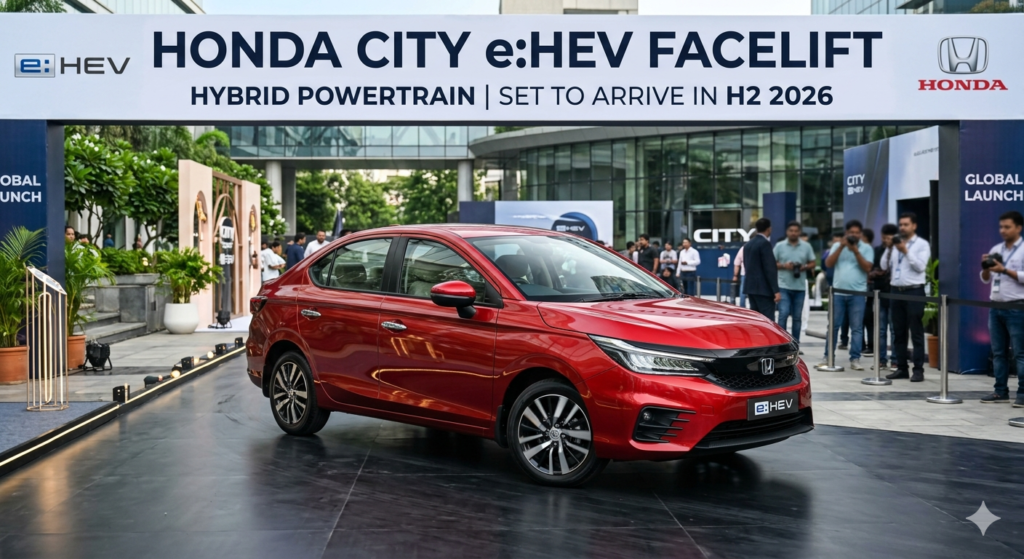
The Honda City, long regarded as one of India’s most reliable and comfortable midsize sedans, is gearing up for its second facelift in the second half of 2026. This update arrives at a critical juncture for Honda, as the City’s market share has slipped significantly in recent years, even as the broader sedan segment continues to shrink.
In the fiercely competitive Indian midsize sedan space, the City now battles the Volkswagen Virtus, Skoda Slavia, and Hyundai Verna. While the Virtus has crossed impressive cumulative sales milestones and continues to perform strongly, the Slavia also maintains healthy demand. The Verna, despite its polarising bold design, manages to deliver decent monthly numbers thanks to its feature-rich cabin and sporty appeal.
In contrast, Honda City sales have declined noticeably. In recent months, the City has often trailed behind its German and Korean rivals in monthly rankings, with Honda Cars India reporting lower volumes for the model amid an overall challenging period for the brand’s domestic sales.
Expected to launch between July and December 2026, the facelift will serve as a stopgap measure to keep the fifth-generation City fresh until the all-new sixth-generation model arrives around 2028.Exterior changes are likely to include:
- Subtle yet sharper styling updates inspired by the global Honda Civic
- Revised front grille and bumpers
- New LED headlamp and taillamp signatures
- Fresh alloy wheel designs
On the inside, expect incremental upgrades such as improved upholstery, a larger touchscreen infotainment system, enhanced Honda Connect connectivity features, and possibly a 360-degree camera in higher variants.Importantly, the mechanicals will remain largely unchanged — a deliberate strategy to maintain reliability and familiarity.
The biggest draw continues to be the City e:HEV strong-hybrid variant. It will receive the same cosmetic and feature updates as the regular petrol models.
- Powertrain: 1.5-litre Atkinson-cycle petrol engine paired with two electric motors
- Combined Output: 126 PS
- Transmission: e-CVT
- Claimed Mileage: Up to 27.26 km/l (ARAI) — one of the highest in the segment
This hybrid system excels in Indian city conditions with seamless electric-only driving at low speeds, excellent refinement, and significantly lower running costs compared to pure petrol rivals. Priced from around ₹19.99 lakh (ex-showroom) currently, the facelifted hybrid is expected to see only a modest price increase.The regular petrol variants will continue with the proven 1.5-litre i-VTEC engine (121 PS / 145 Nm), offered with a 6-speed manual or CVT automatic.
With tightening fuel prices and growing environmental awareness, the City’s hybrid advantage could prove decisive. While the Virtus and Slavia impress with their turbo-petrol performance and composed handling, and the Verna appeals to younger buyers with its features and styling, the City e:HEV stands out for buyers prioritising efficiency, refinement, low ownership costs, and Honda’s legendary reliability. The facelift will ensure the hybrid version does not look dated against its soon-to-be-facelifted rivals.
The overall sedan segment in India has contracted sharply in favour of SUVs and crossovers. Yet, within this space, demand for stylish, feature-packed, and efficient sedans persists among buyers who value a lower centre of gravity, better highway manners, and premium rear-seat comfort.
Honda clearly sees the 2026 facelift as an opportunity to halt the City’s slide and rebuild momentum. By keeping the efficient hybrid alive and giving the car a fresh look, the company aims to remind buyers why the City was once the default choice in this segment.
Whether the updated City — especially its hybrid avatar — can claw back lost market share against the Virtus, Slavia, and Verna remains to be seen. But one thing is certain: the facelift with the hybrid option has arrived just at the right time for Honda to mount a credible defence in a segment that still refuses to disappear completely.Expected price range for the facelifted City (ex-showroom):
- Hybrid e:HEV: ₹20–21 lakh (approx.)