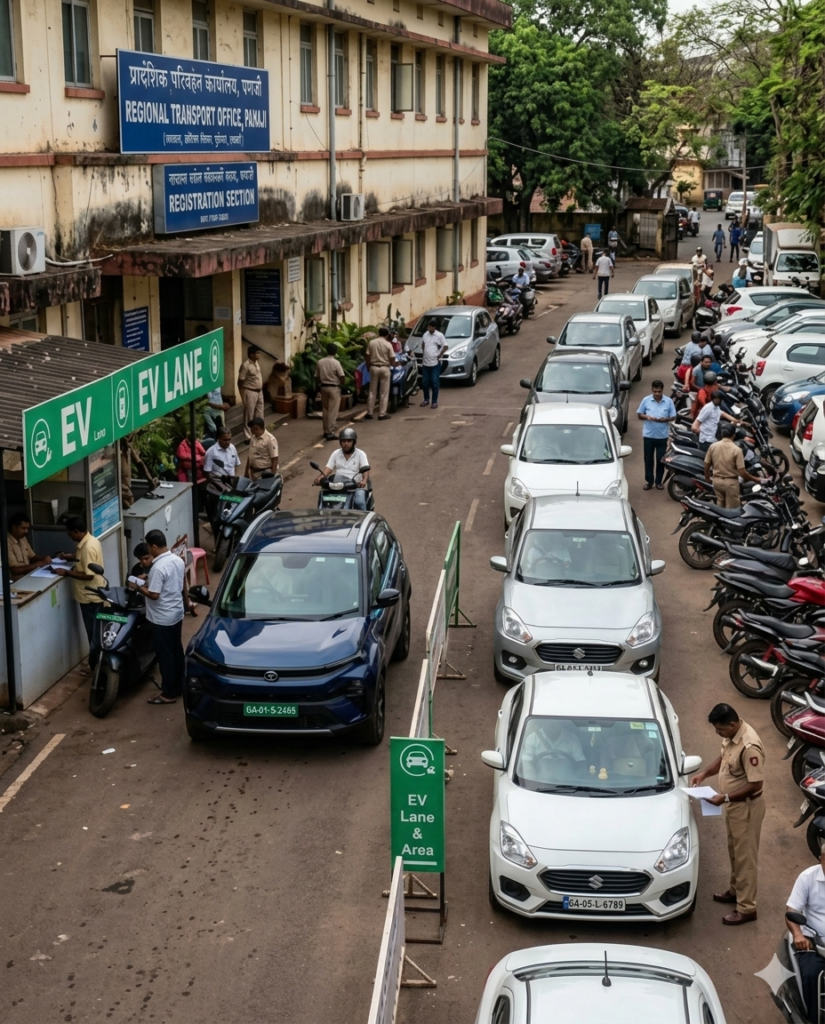
Goa has emerged as a notable performer in India’s electric vehicle (EV) adoption landscape. During the financial year 2024-25 (April 2024 to March 2025), the state ranked second in the country for EV penetration as a share of total vehicle registrations. According to reports from sources like the Council on Energy, Environment and Water (CEEW) and EVreporter analyses of Vahan Dashboard data, Goa’s EV share stood at approximately 11.9% to 11.95%, trailing only Chandigarh (around 12.04%) and ahead of others like Delhi and Kerala. This placed Goa among the top states/UTs for EV penetration, even though larger states like Uttar Pradesh, Maharashtra, and Karnataka led in absolute EV sales volumes.
This strong showing in FY 2024-25 highlighted Goa’s progress in embracing cleaner mobility. Factors contributing to this included state-level incentives, a focus on tourism-friendly and urban segments (such as two-wheelers and three-wheelers), and growing awareness of environmental benefits in a state known for its scenic beauty and sensitivity to pollution concerns. Segment-wise, EVs performed particularly well in categories like two-wheelers (around 15.6% penetration) and three-wheeler goods vehicles (37.5%), reflecting practical adoption in daily commuting and commercial use.
However, two months into 2026 (January and February), the ground reality on Goan roads presents a more balanced — and arguably more muted — picture. Data from the Ministry of Road Transport and Highways (via Vahan records) shows that petrol-powered vehicles, including those with ethanol blends, hybrids, and other internal combustion engine (ICE) variants, continue to dominate new registrations.In January and February 2026 combined, Goa registered a total of 15,263 vehicles. Of these:
- Pure electric vehicles accounted for 1,199 units.
- Battery-operated electric vehicles added another 265 units.
- Strong hybrid electric vehicles contributed 77 units.
This means pure EVs and related battery-operated categories made up roughly 9-10% of the total (around 1,464 electric-related out of 15,263), though exact combined EV share (including hybrids if classified broadly) remains secondary to ICE dominance.
By contrast, petrol vehicles alone totaled 3,603 units. When including petrol-ethanol blended variants (8,286 units), along with petrol-CNG and petrol-hybrid combinations, internal combustion engines overwhelmingly led new purchases. Overall registrations showed steady demand, with 8,160 in January and 7,103 in February, indicating an uptick in vehicle buying but no decisive swing toward full electrification.
This trend aligns with broader observations for 2025 (calendar year), where Goa maintained a respectable EV penetration of around 10-11% in some reports, but ICE options — especially affordable and familiar petrol/ethanol models — retained strong appeal. In a state like Goa, where road infrastructure, tourist mobility needs, and range concerns for longer drives play a role, conventional fuels still offer perceived advantages in availability, refueling speed, and upfront costs for many buyers.
The mixed signals underscore that while policy pushes, subsidies, and infrastructure improvements have boosted EV numbers and placed Goa high in national rankings, widespread adoption faces practical hurdles. Overall vehicle purchases are rising, but the transition remains gradual rather than revolutionary.
Goa’s story illustrates a key aspect of India’s EV journey: impressive relative progress in smaller states/UTs with targeted incentives, yet persistent reliance on conventional vehicles in everyday reality. Sustained growth will likely depend on expanding charging networks, more affordable EV models, and continued policy support to tip the scales further toward electrification in the coming years.