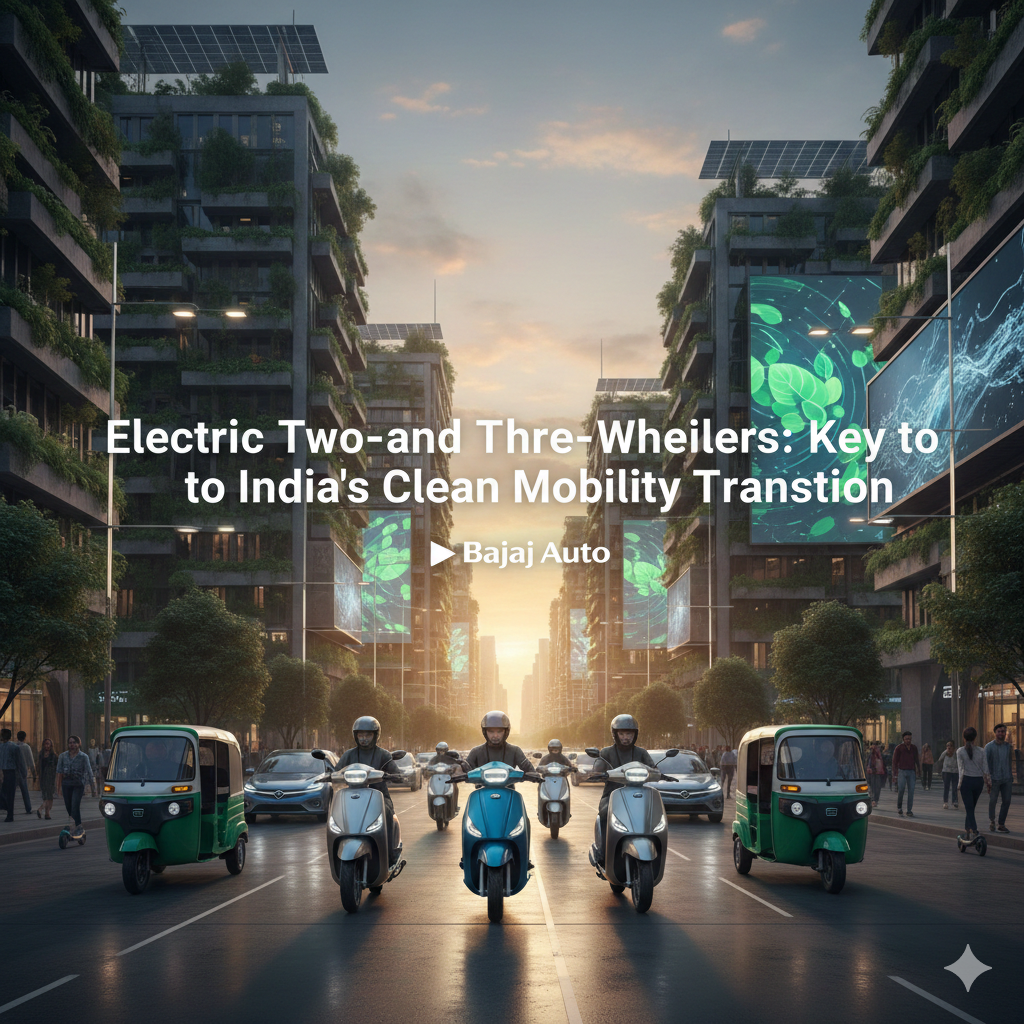
Electric two-wheelers and three-wheelers are emerging as the backbone of India’s clean mobility transition, offering a more practical and cost-effective solution for urban transport than private cars, according to a senior executive at Bajaj Auto.
Speaking at the Symposium on International Automotive Technology (SIAT) 2026, Abraham Joseph, Managing Director of Bajaj Auto Technology Ltd, highlighted that India’s mobility challenges stem more from congestion and space limitations than from long-distance travel needs.
“India’s problem is not distance, it is density. You have far more vehicles than the infrastructure can sustain,” Joseph said, underlining the urgency of adopting compact and efficient electric mobility solutions.
With nearly 260 million two-wheelers currently on Indian roads, compared with around 50 million cars, two- and three-wheelers form the backbone of everyday urban transport. Their smaller size, lower energy consumption, and greater maneuverability make them far better suited for navigating dense city traffic.
Joseph noted that electric two- and three-wheelers significantly reduce operating costs for users while also lowering fuel consumption and carbon emissions. For last-mile delivery workers, commuters, and small business operators, these vehicles offer an affordable and sustainable alternative to conventional petrol and diesel models.
Unlike electric cars, which require large batteries and extensive charging infrastructure, smaller electric vehicles can be deployed more quickly and economically. They also place less strain on urban roads and parking spaces, making them a more scalable solution for Indian cities.
Industry experts believe that accelerating the adoption of electric two- and three-wheelers will play a crucial role in meeting India’s climate goals and improving air quality in major urban centers. Government incentives, expanding charging networks, and falling battery costs are further strengthening this segment.
As India works towards cleaner and more efficient transportation systems, policymakers and manufacturers are increasingly focusing on compact electric mobility. According to Bajaj Auto, prioritizing electric two- and three-wheelers could deliver faster and more impactful results than relying primarily on private electric cars.
With rising congestion and limited infrastructure in most Indian cities, small electric vehicles are likely to remain at the heart of India’s sustainable mobility journey.