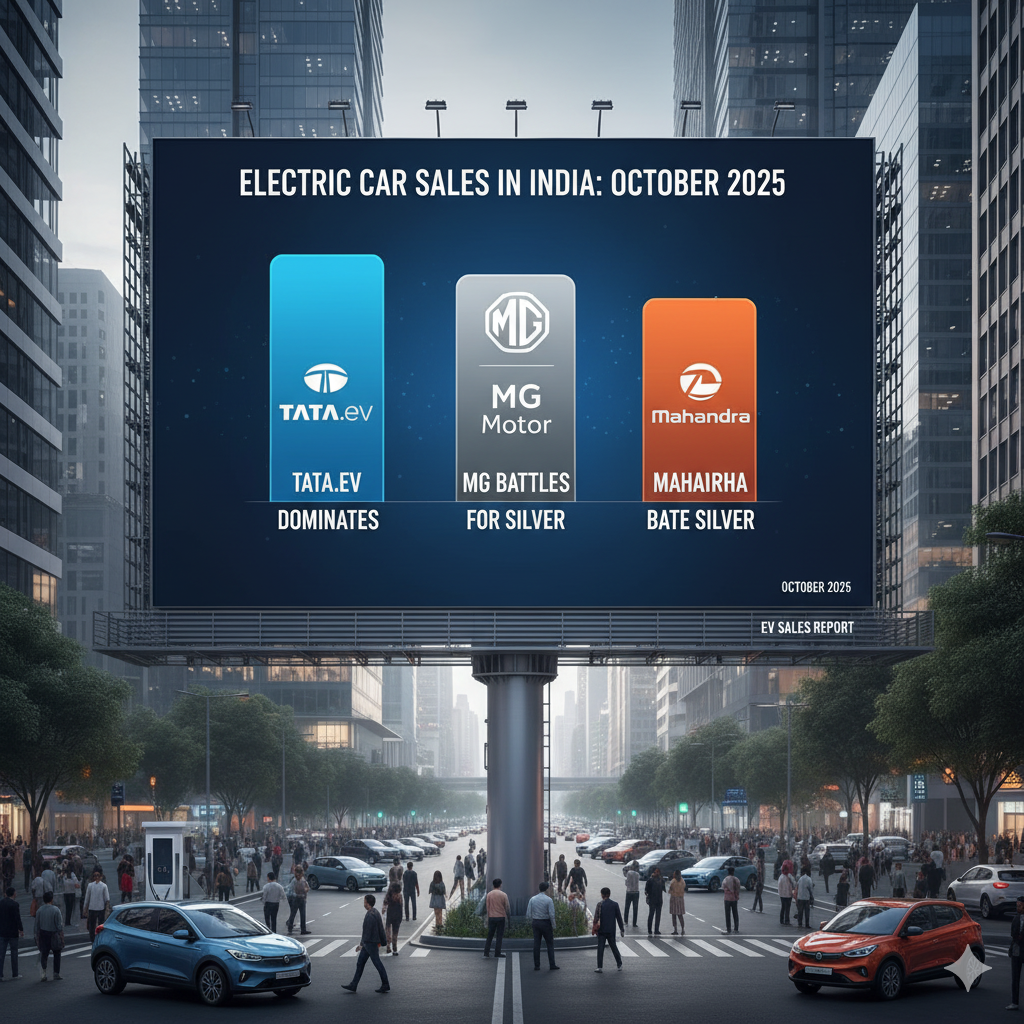
The Indian electric vehicle (EV) market continues its electrifying growth trajectory, with October 2025 sales figures underscoring a landscape dominated by established players. Official data from the Society of Indian Automobile Manufacturers (SIAM) reveals a total of over 16,000 four-wheeler EV units sold last month, marking a 25% year-on-year increase. Leading the charge is Tata.ev, which solidified its market leadership with robust volumes, while MG Motor and Mahindra engaged in a nail-biting contest for the runner-up position. Here’s a comprehensive breakdown of the key brands’ performances.
October 2025 Electric Car Sales: Key Highlights
The month’s sales painted a picture of consolidation among top brands, with Tata.ev capturing nearly 42% of the market share. The top three accounted for over 92% of total sales, leaving limited room for emerging challengers like Kia and BYD to gain traction.
| Brand | Units Sold | Market Share (%) | YoY Growth (%) |
|---|---|---|---|
| Tata.ev | 6,878 | 41.8 | +28 |
| MG Motor | 4,464 | 27.1 | +32 |
| Mahindra | 3,709 | 22.5 | +45 |
| Kia | 615 | 3.7 | +15 |
| BYD India | 524 | 3.2 | +8 |
| Total | 16,190 | 100 | +25 |
Note: Figures are for passenger EVs only (four-wheelers); YoY growth based on October 2024 data.
Tata.ev: Unchallenged Market Monarch
Tata Motors’ EV arm, Tata.ev, delivered another blockbuster month, clocking 6,878 units sold – a staggering 2,414-unit lead over second-place MG. Popular models like the Nexon EV and Punch EV drove this surge, benefiting from aggressive pricing, an expanding charging infrastructure, and strong rural penetration. With a cumulative market share exceeding 60% in 2025 so far, Tata.ev’s strategy of affordable, feature-rich vehicles continues to resonate with India’s price-sensitive consumers. Industry analysts predict Tata could hit 100,000 annual EV sales by year-end, further entrenching its dominance.
MG vs. Mahindra: The Thrilling Duel for Second PlaceOctober’s real drama unfolded in the battle for silver, where MG Motor edged out Mahindra by a slim margin of 755 units.
- MG Motor: Selling 4,464 units, primarily through the ZS EV and Windsor EV, MG maintained its upward momentum. The brand’s focus on urban millennials with premium interiors and ADAS features paid dividends, especially in metro cities like Mumbai and Bengaluru. This marks MG’s fifth consecutive month above 4,000 units, signaling sustained growth.
- Mahindra: Not to be outdone, Mahindra’s EV lineup – led by the XUV400 and the newly launched BE 05 – posted 3,709 units, its best October performance yet. The company’s aggressive expansion into Tier-2 cities and partnerships for battery swapping have narrowed the gap significantly. Mahindra’s 45% YoY growth outpaces the market, positioning it as a dark horse that could overtake MG by Diwali if current trends hold.
Kia and BYD: Struggling to Accelerate
The chasm between the top trio and the rest was stark, highlighting challenges for global entrants in India’s volume-driven EV ecosystem.
- Kia India: Despite its ICE success with models like the Seltos, Kia’s EV foray with the EV6 and EV9 managed only 615 units. High pricing (starting at ₹40 lakh) and limited awareness have hampered adoption, placing Kia at a distant fourth. Kia has hinted at a sub-₹25 lakh model launch in Q1 2026 to boost volumes.
- BYD India: The Chinese giant, known for its Atto 3 and Seal sedans, sold 524 units – a modest uptick but still underwhelming. BYD’s premium positioning appeals to a niche luxury segment, yet it grapples with geopolitical perceptions and supply chain hurdles. With plans for a ₹10 lakh e-hatchback, BYD aims to disrupt the mass market next year.
What These Figures Reveal About India’s EV Future
October 2025’s sales data spotlights a “three-tier” EV market: Tata’s ironclad lead at the apex, a high-stakes skirmish between MG and Mahindra in the middle, and a laggard group of aspirants like Kia and BYD playing catch-up. Broader trends include a 15% month-on-month dip from September’s festive peak, attributed to supply constraints and pre-election caution in some states. However, government incentives under the FAME-III scheme and falling battery costs bode well for deeper penetration.As India targets 30% EV adoption by 2030, these numbers underscore the need for diverse offerings – from budget commuters to luxury crossovers. Stakeholders will watch November closely: Will Mahindra snatch second? Can Kia and BYD ignite a comeback? For now, Tata.ev reigns supreme, powering India’s green mobility revolution.