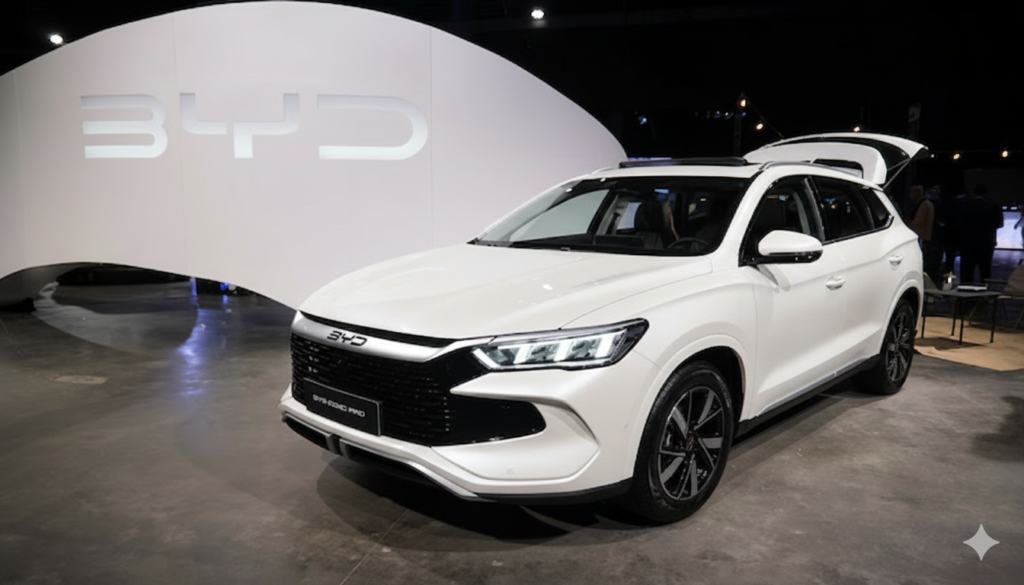
China’s leading electric vehicle (EV) manufacturer, BYD, appears to be quietly reevaluating its approach to the Indian market. As demand for its electric cars surges, with dealers holding hundreds of pending orders, the company is exploring local assembly options to overcome strict import restrictions and high tariffs. This development, reported in late January 2026 by sources close to the matter, signals a pragmatic strategic pivot for BYD in one of the world’s fastest-growing EV markets.
India imposes tight controls on imported vehicles, limiting fully built units (CBUs) of each model to 2,500 per year. This quota has become a bottleneck for BYD, whose sales in India jumped approximately 88% in 2025 (or recent reports cite around 84-88% growth), reaching roughly 5,500 to 6,000 units. Models like the Atto 3 compact electric SUV, eMax7 MPV, Sealion 7, and Seal sedan have driven this momentum, even with import duties reaching up to 110% on fully built cars.
Despite these barriers, BYD’s pricing remains competitive. The Atto 3 starts at around ₹2.5 million (approximately $27,255), positioning it in the premium mass-market segment alongside local players like Mahindra and Tata Motors—yet still undercutting rivals like Tesla’s offerings. The Sealion 7, which sold about 2,200 units last year, ranges from ₹4.9 million to ₹5.5 million, notably below Tesla’s Model Y starting at around ₹6 million.
In contrast, Tesla has resorted to discounts on certain variants to boost sales in India, highlighting the differing trajectories: strong organic demand for BYD versus slower uptake for Tesla amid the same regulatory hurdles.
Rather than pursuing a full-scale manufacturing plant—which India rejected earlier—BYD is now considering semi-knocked-down (SKD) assembly. This involves importing partially assembled components and completing final assembly locally.Key advantages include:
- Lower tariffs: SKD could reduce duties from around 70% to approximately 30%, improving cost efficiency and pricing flexibility.
- Fewer regulatory hurdles: SKD operations are generally easier and cheaper to approve compared to full CKD (completely knocked-down) or full manufacturing setups.
- Scalability: It allows BYD to bypass the 2,500-unit quota per model for imported CBUs while meeting surging demand.
The company is already working on obtaining Indian safety and regulatory certifications for additional models to support this potential expansion. Any final decision is expected to follow visits by senior BYD executives to India.
This rethink comes as BYD seeks to accelerate overseas growth. Domestic sales in China have slowed due to reduced EV subsidies and intensifying competition, pushing the company to target nearly 25% growth in international deliveries in 2026. India, with its rapidly expanding EV market, represents a key opportunity.The move also aligns with a slight improvement in India-China relations, including resumed direct flights following high-level talks. However, policy support remains cautious, and geopolitical sensitivities continue to influence decisions around Chinese investments.
BYD has approached Indian regulators to highlight how import limits could hinder further growth, emphasizing that recent inventory has sold out quickly.
If BYD successfully implements SKD assembly, it could reshape the competitive dynamics in India’s premium and mass-premium EV segments. Lower effective costs might enable more aggressive pricing, increased volumes, and faster market penetration—potentially pressuring local manufacturers like Tata Motors and Mahindra while challenging Tesla’s position.
This approach demonstrates a balanced strategy: deeper commitment to India without the full investment risks of a large plant. It could encourage other global EV players to explore similar hybrid import-assembly models, accelerating overall EV adoption in the country.
For consumers, it promises better availability, potentially reduced waiting times, and more competitive pricing in the premium EV space. For the broader industry, it underscores India’s growing importance as an EV market and the challenges foreign players face in navigating tariffs, quotas, and regulatory approvals.
As BYD targets at least double-digit growth in India for 2026 (building on its strong 2025 performance), this potential local assembly shift could mark a turning point. It highlights both the opportunities in India’s booming EV sector and the persistent hurdles for Chinese automakers.
What do you think—will BYD’s move strengthen Chinese EV presence in India, or will regulatory caution prevail? Share your views!