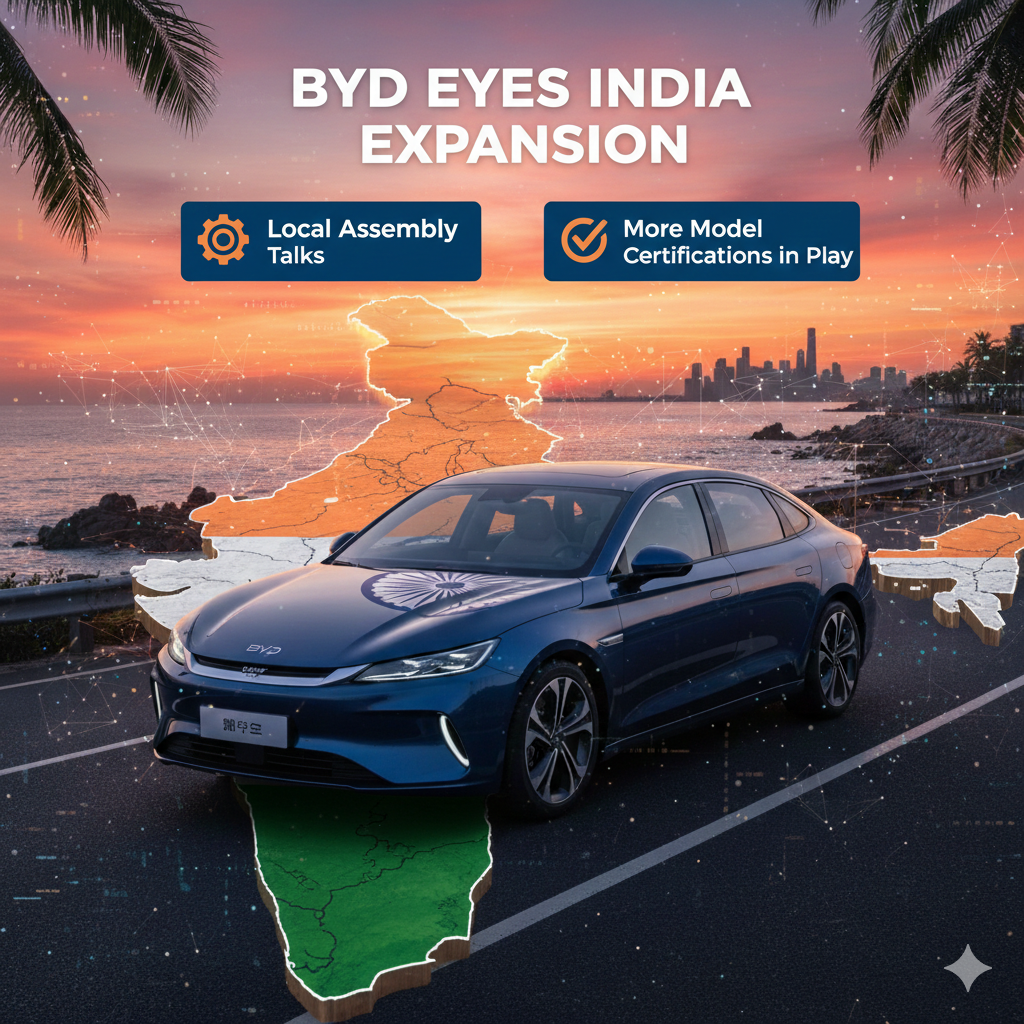
As India’s electric vehicle market continues its rapid growth—despite overall EV penetration hovering around 4.3% in recent years—Chinese giant BYD is ramping up its ambitions in the country. Sources familiar with the matter report that the automaker is actively exploring local assembly options and pursuing safety and regulatory certifications for additional models to bypass strict import quotas and high duties, driven by surging customer demand.
BYD’s India sales jumped approximately 88% in 2025, reaching roughly 5,500 units, a strong performance in a market dominated by local players like Tata Motors and Mahindra. This growth has pushed the company against import limits: under current rules (such as GSR 870(E)), fully built-up (CBU) imports for certain models are capped at 2,500 units per model annually. Models like the Sealion 7 alone consumed about 88% of its quota last year (around 2,200 units), leading to extended delivery waits and hundreds of pending orders at dealerships.
To overcome these constraints and scale faster, BYD is evaluating semi-knocked-down (SKD) assembly—importing partially assembled kits for final local integration at its existing facility in Sriperumbudur, Tamil Nadu. This approach is less capital-intensive and easier to secure regulatory approvals compared to a full-scale manufacturing plant, which India rejected in prior proposals (including a $1 billion joint venture plan years ago). SKD could significantly reduce import tariffs from up to 70-110% on CBUs to around 30%, potentially slashing vehicle prices by 20-30% and making BYD’s EVs more competitive in the premium and mass-premium segments.
The company is also working on obtaining local safety and regulatory certifications (homologation) for more models, allowing greater import flexibility or expanded local assembly beyond the current lineup. Currently, BYD offers four models in India:
- Atto 3 (compact e-SUV, assembled locally from CKD kits, starting around ₹24.99 lakh)
- eMax 7 (e-MPV, also locally assembled)
- Seal (luxury sedan, imported CBU)
- Sealion 7 (mid-size e-SUV, imported CBU, priced ₹48.90-54.90 lakh)
Models in the pipeline for potential localization or certification include the Atto 3 (already partially localized), Seal, and possibly Sealion 6/7 hybrids or related variants, as BYD looks to broaden its portfolio with plug-in hybrids alongside pure EVs.This push signals serious long-term intent from BYD, which has maintained a limited presence in India for years (primarily through the Atto 3). With an existing assembly capacity of 10,000-15,000 units annually in Chennai/Tamil Nadu and a growing network of 47 dealerships across 40 cities, the company is well-positioned to challenge established players in India’s passenger vehicle market (over 4.5 million units annually).
Lower prices through localization could accelerate EV adoption, intensify competition against Tata, Mahindra, and emerging rivals, and help BYD capture more share in a market where affordability remains key amid high import barriers. While geopolitical factors and policy support for Chinese investments remain inconsistent—despite improving India-China relations and resumed direct flights—BYD’s proactive steps reflect confidence in India’s EV future.
Any major moves, including senior executive visits (some delayed), will likely precede concrete announcements. For now, the strategy focuses on dodging high duties, easing supply bottlenecks, and scaling to meet demand in one of the world’s most promising EV growth stories.