The EV boom in India has accelerated dramatically over the past five years, transforming urban commuting and drawing in a wave of players—from global giants and established domestic names to innovative homegrown startups focused on making electric mobility accessible and practical.
Amid this surge, Blinq Mobility, a promising EV startup headquartered in Gurugram, is quietly making waves with its vision for affordable, city-centric electric vehicles. Founded by a team of IIT Delhi alumni (with roots in the AXLR8R Formula Racing team) and including a former Tesla engineer, Blinq is targeting high-usage urban scenarios like ride-hailing fleets and daily commuters who need reliable, low-downtime options.
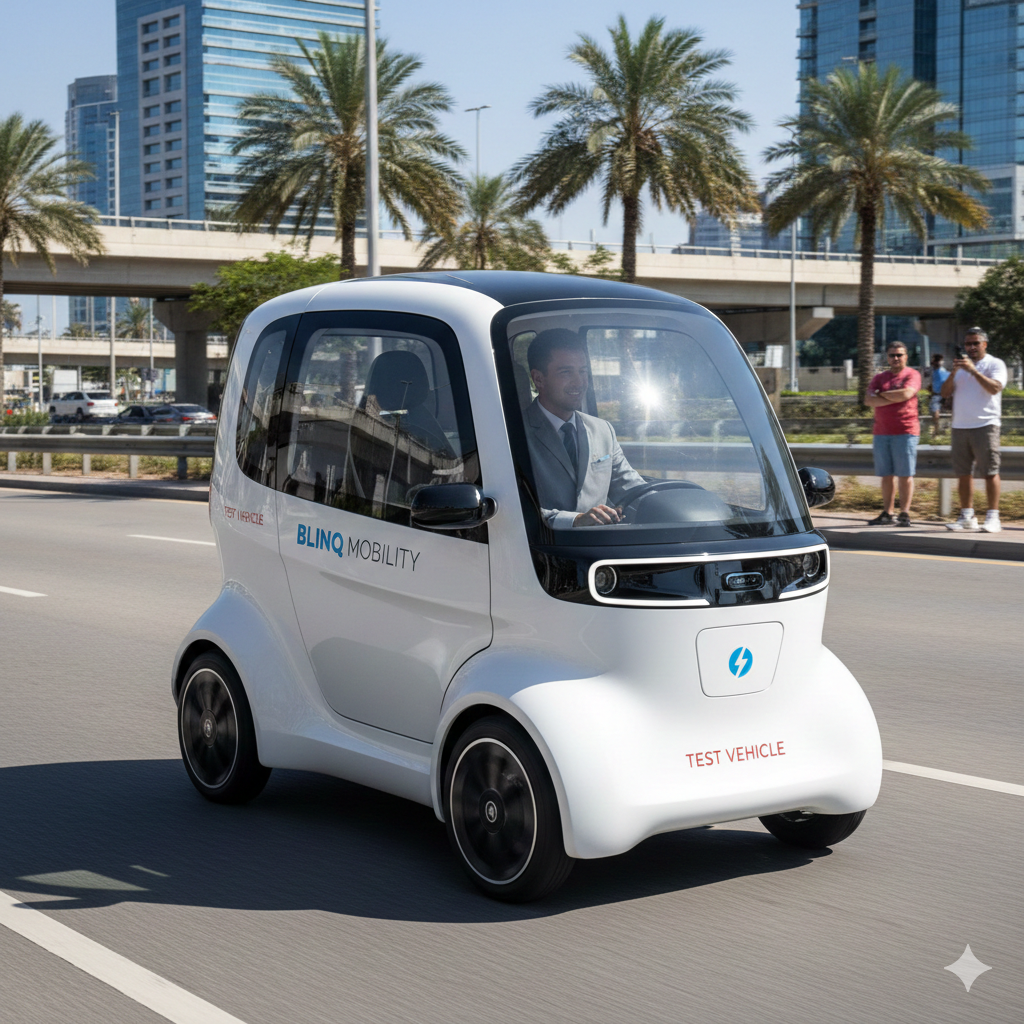
A recent milestone has captured attention across social media and EV circles: the company has taken its first working prototype—internally dubbed “Car 1” (previously referred to as “Pod”)—out for real-world on-road testing. Videos circulating online show this compact micro EV navigating public roads, marking a crucial shift from digital designs and simulations to tangible, drivable reality.
Blinq isn’t chasing long-range luxury EVs; instead, it’s engineering modular, battery-swappable electric pods optimized for dense Indian cities. Key highlights include:
- Rapid battery swapping — Drivers can exchange a depleted battery for a fully charged one in minutes (similar to refueling a petrol vehicle), eliminating the long wait times of traditional charging. This is especially valuable for fleet operators where downtime directly impacts earnings.
- Affordability focus — The company aims to deliver a four-wheeler experience at roughly the price of a three-wheeler auto-rickshaw, achieved partly through a model where customers own the vehicle but treat the battery as a service (reducing upfront costs by up to 40%).
- Urban-friendly design — Compact dimensions for navigating tight traffic, air-conditioned comfort, and emphasis on safety and efficiency in crowded streets.
- Fleet-first strategy — Pilots are planned with ride-hailing partners and early customers in controlled environments, with broader rollout tied to certification progress.
Blinq Mobility seems to be targeting buyers who are looking for a low-cost, efficient, and eco-friendly alternative to conventional petrol cars and two-wheelers. With rising traffic and limited parking space in Indian cities, micro EVs can offer a practical solution for daily commuting.
These vehicles are expected to appeal to:
- Office commuters
- Students
- First-time car buyers
- Last-mile delivery operators
- Ride-sharing and fleet operators
If priced competitively, micro EVs could bridge the gap between electric two-wheelers and full-sized electric cars.
Although official specifications have not yet been revealed, the test vehicle gives some early clues about Blinq Mobility’s direction:
- Compact Design: Suitable for narrow city roads and tight parking spaces
- Lightweight Platform: Likely focused on energy efficiency
- Urban-Oriented Range: Designed mainly for short daily trips
- Cost-Focused Engineering: Aimed at keeping ownership affordable
Road testing is a crucial stage in vehicle development, as it helps manufacturers evaluate battery performance, suspension setup, braking, and durability under real traffic conditions.
India’s EV ecosystem has witnessed strong participation from start-ups in recent years. Along with established manufacturers, new players are experimenting with innovative formats such as micro cars, quadricycles, and shared mobility vehicles.
Start-ups like Blinq Mobility are trying to address gaps in the market by offering practical, budget-friendly electric vehicles that cater specifically to Indian road and usage conditions.
This approach aligns well with India’s broader push toward sustainable transport and reduced dependence on fossil fuels.
Since the vehicle is currently undergoing road tests, it is likely that Blinq Mobility is still in the validation and refinement phase. Typically, manufacturers conduct extensive testing for several months before announcing pricing and launch timelines.
If development progresses smoothly, the company may reveal more details about:
- Battery capacity
- Driving range
- Charging time
- Safety features
- Pricing strategy
in the coming months.
The sighting of Blinq Mobility’s micro EV prototype on Indian roads is an encouraging sign for the country’s growing electric mobility sector. It reflects the increasing confidence of start-ups in developing homegrown, affordable EV solutions.
As urban mobility challenges continue to rise, compact electric vehicles like this could play an important role in shaping the future of city transport. If Blinq Mobility succeeds in delivering a reliable and competitively priced product, it could emerge as a strong contender in India’s evolving EV market.