Renault is accelerating its resurgence in the Indian market with an ambitious product offensive focused on SUVs, hybrid powertrains, and electric vehicles. As part of its broader “futuREady” strategy and International Game Plan, the French automaker plans to launch multiple new models by 2030, with India serving as a key hub for design, development, and assembly. This push aims to capture greater market share in the fast-growing SUV and electrification segments while addressing diverse customer needs from urban commuters to family buyers.
Renault has confirmed plans for four new models to be designed and assembled in India by 2030, emphasizing multi-energy platforms that support petrol, strong hybrids, and full EVs. The lineup prioritizes SUVs, hybrids for efficiency in traffic-heavy conditions, and EVs as the market matures.
- New-Generation Renault Duster (Launched/Expanding in 2026)
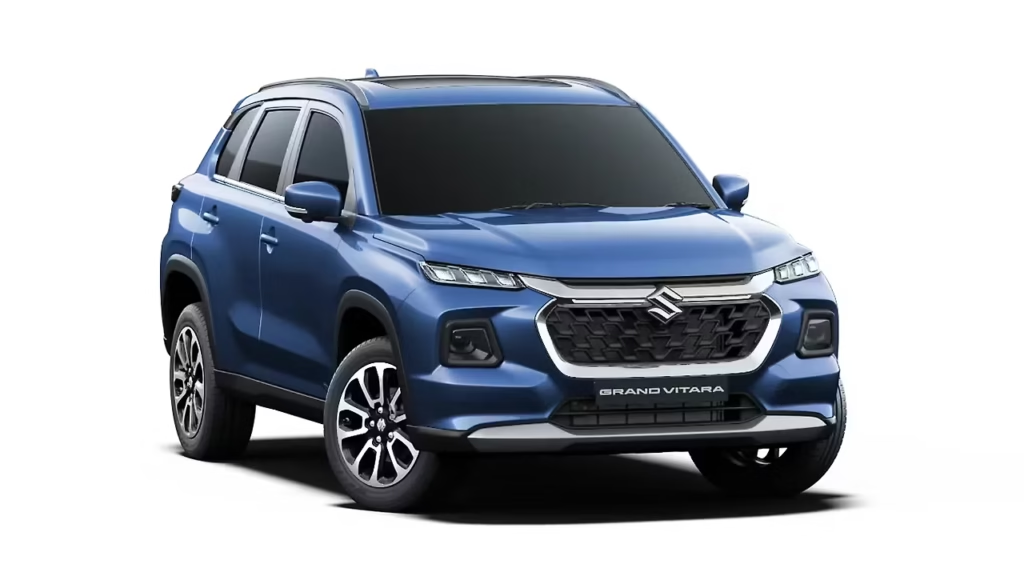
The iconic Duster has made a strong comeback, unveiled in early 2026 with prices starting around ₹10.49 lakh (ex-showroom). Built on a multi-energy platform, it offers turbo-petrol engines and introduces Renault’s first strong hybrid (E-Tech) variant in India — a 1.8L setup delivering around 160 hp combined output, with significant electric-mode driving in cities (up to 80% claimed). The hybrid version is slated for wider availability around Diwali 2026, with high demand already leading to sold-out allocations for the year. This positions the Duster against rivals like the Hyundai Creta, Maruti Grand Vitara, and Toyota Hyryder in the mid-size SUV space. - Renault Boreal (Bigster) – 7-Seater SUV (Expected Mid-2026)
A larger family-oriented SUV previewed globally as the Bigster, the Boreal targets the growing 7-seater demand. It shares underpinnings with the Duster and is expected to offer petrol and hybrid options, focusing on spacious interiors, premium features, and versatile family use. Launch targeted around July 2026. - Bridger Concept-Based Compact SUV (Expected 2027)
Revealed as the Bridger Concept, this sub-4m SUV previews a rugged, high-ground-clearance model designed and engineered in India. It will support multiple powertrains — petrol, hybrid, and full EV — with class-leading efficiency promised for the electric variant. Production starts next year, with India as the debut market before global rollout. - Sub-4m “Mini Duster” SUV (Expected Diwali 2027)
Internally codenamed RB3-K2 or similar, this compact SUV (positioned below the Duster) draws inspiration from the Bridger’s butch design. It aims to rival the Maruti Brezza, Hyundai Venue, and Mahindra XUV 3XO, with a diverse portfolio including petrol, hybrid, CNG, and EV options (potentially 35 kWh or 55 kWh batteries). Expected to be one of the most powertrain-flexible models in its segment.
Additionally, Renault is advancing its EV roadmap with models like the Kwid EV (targeted for around 2027) to make electric mobility more accessible and affordable.
Renault’s strategy shifts focus to SUV dominance, hybrid leadership (positioning hybrids as a practical bridge to full electrification), and localized production to improve affordability and features. With India identified as a central pillar for global growth, these launches leverage multi-energy platforms for flexibility amid evolving regulations and buyer preferences.
The brand aims for annual volumes in the lakhs through this offensive, targeting 3-5% market share by 2030. Early response to the new Duster — including overwhelming demand for the hybrid — signals strong potential.
Renault’s renewed emphasis on SUVs, efficient hybrids, and future-ready EVs positions it to compete aggressively in one of the world’s most dynamic auto markets. Watch for more details on pricing, features, and exact timelines as these models roll out over the coming months and years.